Vapour Degreasing & Industrial Component Cleaning Services in Bangalore
Pre-NDT Cleaning · Pre-Inspection Surface Preparation · AMS 2692 · ASTM E165 · NAS 410 Aerospace · Automotive · Pressure Vessels · Boilers · Hydraulics · Precision Machined Parts NABL + NADCAP Accredited Facility · Peenya, Bangalore, India
- 🧪Residue-Free Guaranteed
- ☑️Water-Break Test Verified
- ⏰Same-Day Service Available
- ✈️NADCAP Aerospace Approved NDT Testing Facility
Why the Most Experienced NDT Teams Degrease Before Every Inspection
There is a reason that ASTM E165, ISO 3452-1, ASTM E1444, NAS 410, and every serious NDT standard contains a mandatory pre-cleaning requirement. Surface contamination — oil, grease, cutting fluid, hydraulic fluid, preservation coating, fingerprint residue, and metallic scale — is the primary cause of missed indications in Liquid Penetrant Testing, Magnetic Particle Inspection, and Visual Testing.
A crack as fine as 0.01mm that would produce a vivid fluorescent indication on a clean surface can produce nothing — an absolute zero indication — on a surface contaminated by a layer of oil that is invisible to the naked eye.
Vapour degreasing solves this completely. When a component is lowered into the vapour zone of a degreaser, pure solvent vapour condenses on every surface — including the inside of cracks, pores, blind holes, threaded features, and every geometric detail inaccessible to a wipe or spray. The contamination dissolves. The component emerges dry, chemically clean, and verified residue-free by water-break test. The NDT inspector then works on a surface where every defect is accessible.
Degreasing Solutions at Trinity NDT in Bangalore
Trinity NDT WeldSolutions provides professional vapour degreasing and precision industrial component cleaning services at its NABL ISO/IEC 17025:2017 accredited and NADCAP Aerospace Merit approved facility in Peenya, Bangalore. We clean components for our own NDT inspection services — and as a standalone service for clients who bring components for cleaning before their own or third-party inspection.
Whether you need pre-PT, pre-MT, pre-FPI, pre-ET, or pre-surface treatment cleaning — or simply need a batch of precision machined components brought to assembly cleanliness — our degreasing service delivers the result you need with full documentation for your quality records.
Currently serving customers: Hindustan Aeronautics Ltd(HAL), BEML, Aerospace companies in Bangalore and auto ancillaries. That demand for high quality degreasing services specifically for export oriented machined components. Spread across Peenya, Bommasandra, Dabaspet, Whitefield, Jigani and Doddaballpur industrial Areas in the city of Bangalore.
What Is Vapour Degreasing? — The Process Explained
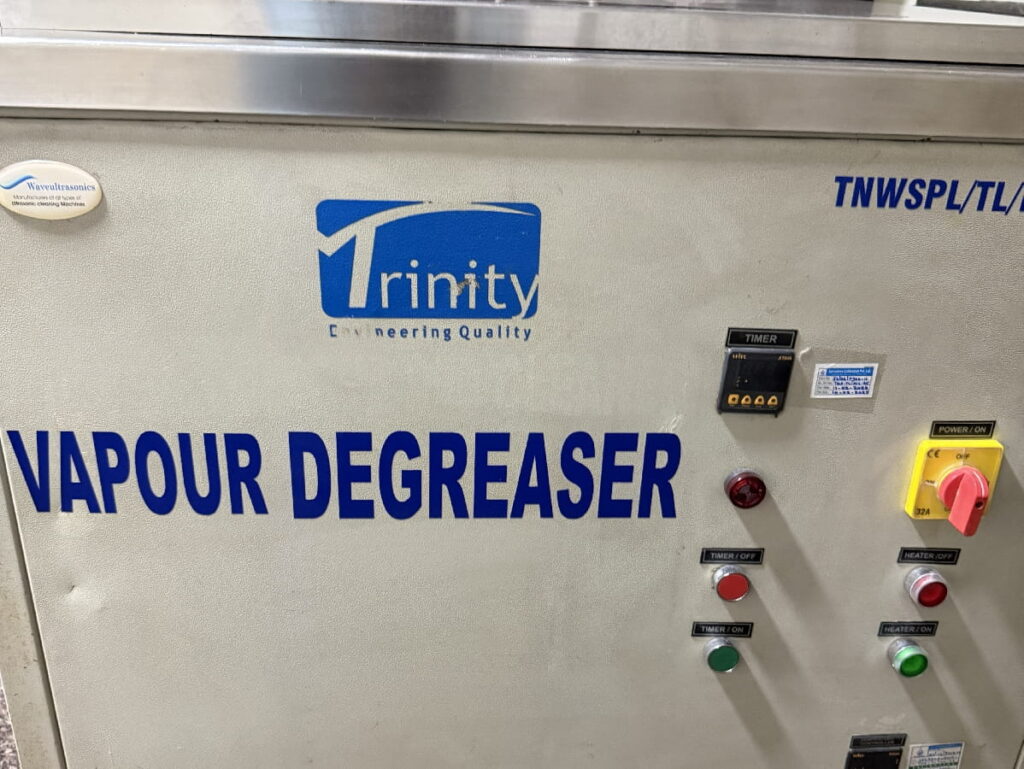
Vapour degreasing is a closed-loop solvent cleaning process that uses the vapour phase of a solvent, not liquid wiping or spray washing, to clean metallic and non-metallic components to a verified hydrocarbon free surface condition.
The fundamental principle: a solvent is heated to boiling in the lower sump of the degreaser. Pure solvent vapour rises and fills the vapour zone above the liquid.
A cold component lowered into the vapour zone causes condensation — clean solvent condenses on every surface of the part, dissolves the contamination, and drains back to the sump. The contamination settles in the sump. The vapour zone always remains clean.
This process is fundamentally different from solvent wiping or spray washing:
– Wiping physically moves contamination. It often re-deposits it in cracks
– Spray washing misses internal features and complex geometries
– Vapour degreasing penetrates every surface regardless of geometry —including the inside of discontinuities that will be inspected by PT or ET
The result is a surface where every defect is accessible to penetrant, magnetic particles, or eddy current — the physical prerequisite for reliable NDT.
6 Stages of Vapour Degreasing Process at Trinity nDT, Bangalore
How Vapour Degreasing Works — 6 Stages
Component assessed for contamination type, material, geometry. Heavy particulate removed before degreaser entry.
Component lowered into pure solvent vapour. Condensation begins on all surfaces — cleans inside cracks and blind features.
Heavily contaminated parts receive additional boiling liquid immersion — mechanical cleaning action from hot solvent.
Component receives final clean vapour until surface reaches vapour temperature — condensation stops, part is clean.
Slow extraction through freeboard zone — solvent vapour returns to sump, part exits dry with zero residue.
Water-break test performed. Clean surface shows complete uniform wetting — no beading. Component released for NDT.
Why Surface Contamination Destroys NDT Reliability — And How Degreasing Fixes It
| NDT Method | Effect of Contamination | How Degreasing Solves It | Applicable Standard |
|---|---|---|---|
|
PT / FPI Penetrant Testing / Fluorescent Penetrant |
Oil blocks crack mouth — penetrant cannot enter. Even a film invisible to naked eye prevents capillary action. Real cracks produce zero indication. | Vapour penetrates crack interior — removes oil from inside the discontinuity. Penetrant can now enter every surface feature completely. |
ASTM E165 ISO 3452-1 AMS 2644 NAS 410 |
|
MT / MPI Magnetic Particle Inspection |
Oil film holds particles in suspension — particles cannot migrate to flux leakage fields. A 25-micron oil film suppresses indication formation. Cracks missed. | Zero oil residue = full particle mobility. Magnetic particles respond only to flux leakage — every indication forms cleanly and clearly. |
ASTM E1444 ASME Section V NAS 410 AMS 2640 |
|
VT Visual Testing |
Surface oil obscures fine cracks, pores, and dimensional features at weld toes. Grease traps abrasive particles masking surface relief details. | Clean surface reflects light uniformly — fine surface features visible. Inspector sees actual surface condition — not contamination layer. |
ISO 17637 AWS D1.1 ASME Sec.V Art.9 |
|
ET Eddy Current Testing |
Variable oil film creates inconsistent probe liftoff — introduces noise into impedance plane. Shallow crack signals lost in liftoff variation noise. | Uniform clean surface = consistent liftoff = stable impedance plane. Smallest crack signals visible without liftoff interference. |
ASTM E426 AMS 2632 NAS 410 |
|
UT (Contact) Ultrasonic Testing |
Oil / grease contamination creates variable coupling conditions. Unstable near-surface echoes, inconsistent DAC reference curves. | Uniform clean contact surface = repeatable coupling = stable DAC calibration and reliable near-surface resolution. |
ASTM E114 ASME Section V Art.4 |
Industries We Serve — Components We Clean
Aerospace & Defence
Turbine blades/discs, airframe structural members, landing gear assemblies, fastener panels, titanium alloy components, aluminium structural brackets, engine casings — per AMS 2692, AMS 2747
Automotive & Forging
Crankshafts, connecting rods, steering knuckles, gear sets, wheel hubs, suspension arms, forged transmission components, injection moulding inserts
Pressure Vessels & Heat Exchangers
Nozzle welds, shell plates, flange faces, tube sheet faces, manway welds, saddle welds, header assemblies — pre-PT and pre-RT inspection
Boilers (IBR / ASME Section I)
Boiler drums, header end plates, tube-to-tubesheet welds, downcomers, steam pipes — IBR and ASME pre-inspection cleaning
Hydraulics & Pneumatics
Valve bodies, actuator cylinders, manifolds, pump housings, servo valve blocks — assembly cleanliness and pre-inspection cleaning
CNC Machined Precision Component
Turned, milled, and ground precision parts for aerospace, automotive, medical, and defence — removing cutting fluid, coolant, and preservative oil
Materials Accepted for Vapour Degreasing
Vapour degreasing works on any material on which the selected solvent is chemically compatible. Below is our standard accepted materials list. For titanium and aluminium alloys requiring aerospace specification cleaning (AMS 2747 / AMS 2692), please specify at enquiry stage so we can confirm solvent compatibility.
Ferrous Metals:
- Carbon Steel — all grades
- Low-Alloy Steel (P1 through P15)
- Stainless Steel — 304, 316, 321, 347, Duplex, Super Duplex
- Chrome-Moly Steel — P11, P22, P91, P92
- Cast Iron (grey, ductile, malleable)
- Tool Steel and Die Steel
- Maraging Steel
Non-Ferrous & Special Materials:
- Aluminium Alloys — 2024, 6061, 7075, cast aluminium
- Titanium Alloys — Ti-6Al-4V and others (AMS 2747 compliant solvent)
- Nickel Alloys — Inconel 625/718, Monel, Hastelloy
- Copper and Copper Alloys — Cu-Ni, Admiralty,
- Brass, Bronze
- Cobalt Alloys
- Magnesium Alloys (solvent compatibility confirmation required)
- Hardened and Ground Bearing Steels
Specifications & Standards We Work To
| Standard | Title | Applicable To |
|---|---|---|
| AMS 2692 | Vapour Degreasing of Aerospace Parts and Components | All aerospace metals except titanium |
| AMS 2747 | Cleaning Titanium and Titanium Alloy Parts | Ti-6Al-4V and all Ti alloys — approved solvents only |
| AMS 2644 | Penetrant Inspection — Pre-Cleaning Requirement | Aerospace FPI pre-cleaning |
| AMS 2640 | Magnetic Particle Inspection — Pre-Cleaning Requirement | Aerospace MPI pre-cleaning |
| ASTM E165 | Standard Practice for Liquid Penetrant Examination | All industries PT pre-cleaning requirement |
| ASTM E1444 | Standard Practice for Magnetic Particle Testing | All industries MT pre-cleaning requirement |
| NAS 410 (Rev 5) | Aerospace NDT — Cleaning Process Control | NADCAP FPI/MPI pre-cleaning process control |
| ISO 3452-1:2021 | Penetrant Testing — General Principles | International PT pre-cleaning requirement |
| ASME Section V Art. 6 & 7 | Surface Preparation for PT and MT | Pressure vessel and boiler component pre-inspection |
Why Manufacturing Companies Choose Trinity NDT for Degreasing Services
NADCAP Aerospace Merit Accredited Process
Our vapour degreasing process operates within a NADCAP Aerospace Merit accredited facility — the highest global aerospace quality standard. When aerospace primes and NADCAP auditors review our cleaning records, they see a process that is controlled, documented, and audited to aerospace production quality requirements.
High-Temperature Component Capability
Components from service — removed from operating boilers, furnaces, or process equipment — arrive at elevated temperature or with heat-affected surface conditions. We handle thermally challenging components with appropriate dwell times and temperature-resistant equipment configurations.
NDT Immediately After Cleaning — One Facility
When you send your components to Trinity NDT for degreasing, the cleaned component can proceed directly to NABL-accredited PT, MT, ET, UT, or VT inspection in our laboratory — same facility, same visit, complete quality chain. No cross-contamination risk from transport.
No Re-Magnetisation of Ferromagnetic Parts
Components that require Magnetic Particle Inspection after degreasing must not be re-magnetised by the cleaning process. Our degreasing equipment operates without electromagnetic fields — components arrive at the MT station in a demagnetised condition appropriate for MPI.
Documented Cleaning Record Issued
Every batch receives a cleaning record — component description, solvent used, temperature parameters, cycle time, cleanliness verification method (water-break test result), operator identity, and date. This documentation satisfies ISO 3834 welding quality records, NADCAP audit requirements, and ASME/API inspection records.
Same-Day Service for Urgent Inspection Schedules
Plant shutdowns don't wait. Offshore rotations don't slip. When your inspection window is measured in hours, we provide same-day degreasing and NDT service for components received before 10 AM on working days.
How to Use Our Vapour Degreasing Service — Simple 5-Step Process
WhatsApp or call us with: component description, material, quantity, dimensions, contamination type, applicable specification (AMS 2692, ASTM E165, NAS 410, or other), and whether NDT is required immediately after cleaning. We confirm acceptance, turnaround time, and pricing within 2 hours.
Components are delivered to: #491, 14th Cross, 4th Phase, Peenya Industrial Area, Bangalore 560058. For large or heavy components, contact us to arrange loading access. For Peenya and nearby area clients — same-day walk-in service is available. Pan-India courier/freight reception available with advance notice.
Each component is assessed on arrival — contamination type, geometry, material confirmation. Appropriate solvent, temperature parameters, and cycle configuration selected. Components processed through the vapour degreasing cycle. Heavy contamination or complex geometry — 2-stage process applied.
Every batch is verified by water-break test — water applied to cleaned surface must sheet uniformly (no beading) to confirm hydrocarbon-free condition. UV fluorescence check applied where residual oil sensitivity is critical (aerospace FPI applications). Cleaning record completed and signed.
Components returned to client immediately after cleaning with cleaning record. If NDT is required: components proceed directly to our NABL-accredited inspection lab — PT, MT, ET, VT, UT — without leaving the facility. NABL inspection report issued covering both cleaning and inspection results.
Why Vapour Degreasing Outperforms Other Pre-NDT Cleaning Methods
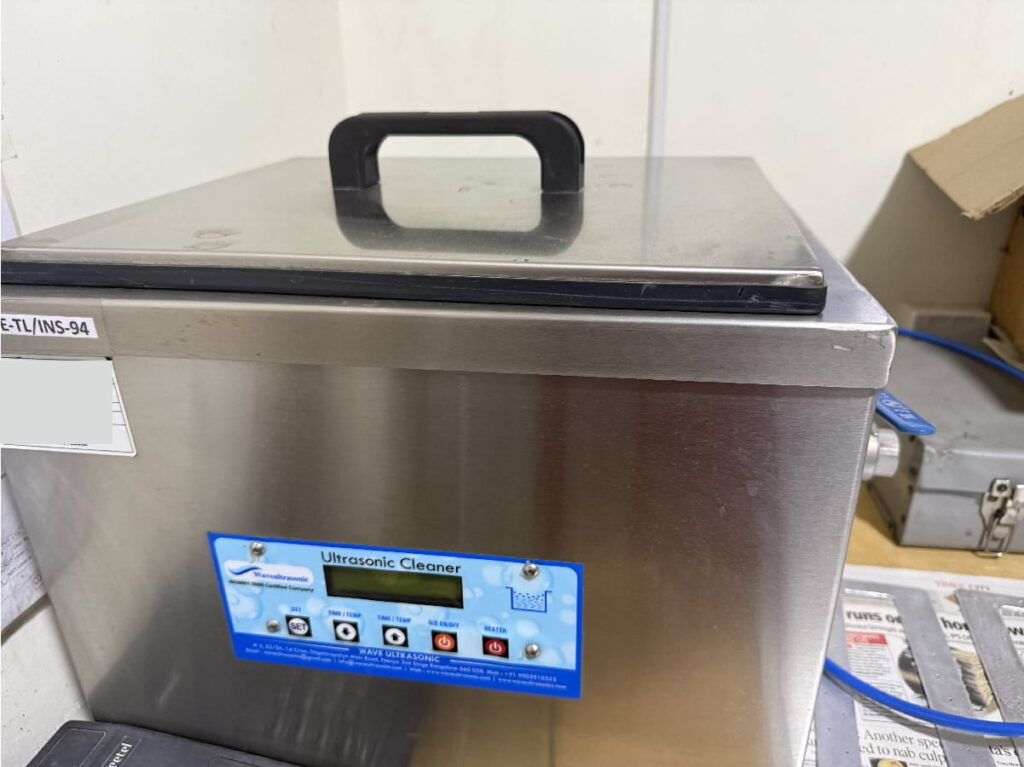
Multiple cleaning methods exist for industrial components. Understanding the limitations of each — and when vapour degreasing is the only reliable option — helps you make the right choice for your specific inspection requirement.
| Cleaning Method | Petroleum Oil Removal | Inside Cracks/Blind Holes | Residue-Free Result | Speed | NDT Ready? |
|---|---|---|---|---|---|
| Vapour Degreasing ✅ | Excellent | Excellent | Guaranteed | Fast (5–15 min) | Immediately |
| Solvent Wipe / Rag Clean | Partial | ❌ Cannot reach | ❌ Residue remains | Fast | Often not ready |
| Aqueous Alkaline Wash | Good for water-based oils | Partial | Requires drying | Moderate | After full drying |
| Ultrasonic Cleaning (Aqueous) | Excellent (with detergent) | Good | Requires drying | Moderate | After full drying |
| Shot / Grit Blasting | ❌ Not effective | ❌ Cannot reach | Surface only | Fast | MT/PT with caution |
| Acid Pickling / Etching | Partial | Partial | Neutralisation required | Slow | After neutralisation |
Our Degreasing Service Capacity & Scope
Components up to [your tank size] in any single dimension. Contact us for oversized components — selective cleaning options available.
Individual components up to [your max weight] kg. Batch baskets — up to [batch weight] kg per cycle.
Up to 500 small-medium components per day. Bulk batch cleaning for automotive production runs.
Standard: Same day for components received before 2 PM. Urgent: Priority processing on request. Bulk: 24–48 hours depending on volume.
Complete Pre-NDT Package — Degreasing + NABL Accredited Inspection
🏆 One Facility — Complete Quality Chain — One NABL Report
Instead of cleaning your components at one location and transporting them to a separate NDT lab — with contamination risk at every handling step — Trinity NDT provides the complete service under one roof:
Vapour Degreasing
+ Water-Break Verification
NABL Accredited NDT
(PT / MT / ET / VT / UT)
Single NABL Report
Cleaning + Inspection
- Zero contamination risk between cleaning and inspection
- Single quality document — accepted by all AIA, TPI, and client QC teams
- Faster turnaround — no inter-facility transport time
- NADCAP Aerospace Merit process for aerospace FPI/MPI applications
- NABL certificate for both cleaning record and NDT result
⚡ Urgent Enquiry?
For same-day or urgent degreasing requirements, WhatsApp or call directly — we confirm availability within 30 minutes.
💬 WhatsApp Now 📞 Call: +91 98441 29439
📧 info@trinityndt.com
🕒 Mon–Sat | 9 AM–6 PM IST
📍 Peenya Industrial Area, Bangalore
Components received before 2 PM on working days can be cleaned and returned same day. Call to confirm availability before dispatching.
PT · MT · ET · VT · UT — all available immediately after degreasing in our NABL accredited laboratory. One facility. One visit. One report.
Frequently Asked Questions — Vapour Degreasing Service
Vapour degreasing is highly effective against all petroleum and hydrocarbon-based contamination: mineral oils, cutting fluids, machining coolants (oil-based), hydraulic fluids, preservation and storage oils, drawing lubricants, press oils, fingerprint and hand oils, wax-based coatings, and flux residues (certain types). However, it is less effective against inorganic contamination such as heavy oxide scale, rust, metallic particles, and water-based coolant residues — these may require additional pre-treatment (light blasting or alkaline washing) before degreasing.
Yes — with the correct solvent selection. Titanium alloys are highly susceptible to stress corrosion from certain chlorinated solvents. We use only solvents approved under AMS 2747 (Cleaning Titanium and Titanium Alloy Parts) for titanium components.
Every batch is verified by water-break test — the standard acceptance criterion for hydrocarbon-free surface condition. A small quantity of clean water is applied to the cleaned component surface. On a hydrocarbon-free surface, the water sheets uniformly with no beading or break — this is called a “water-break free” condition.
Our degreasing capacity is suited to individual components, machined parts, weld test coupons, nozzle assemblies, and small-to-medium fabricated parts. For large pressure vessel shells, heads, or major structural assemblies that exceed our tank capacity, we offer selective area degreasing.
Yes — every batch receives a formal Cleaning Record documenting: component description and batch quantity, solvent type used, degreasing parameters (temperature, cycle configuration), operator identification, date and time,
water-break test result (pass/fail), and any special observations.
Yes — we receive components sent by courier, road freight, and air freight from across India. For components being shipped, please: (1) pack to prevent physical damage in transit; (2) use clean packaging materials — cardboard contaminated with oil or grease can re-contaminate clean packaging areas; (3) send us the tracking number and expected delivery date so we can plan your batch; (4) for urgent requirements, call +91 98441 29439 before shipping to confirm our current availability and turnaround commitment. Return shipping can be arranged at your cost.
Both are effective precision cleaning methods but with different strengths. Vapour degreasing excels at removing petroleum and hydrocarbon-based oils to a completely residue-free, dry surface condition. Whereas, Ultrasonic cleaning excels at removing particulate contamination, buffing compounds, polishing media, and water-soluble soils from complex geometries. It requires drying after cleaning.
Our Other Services: NABL ISO17025:2017 Accredited NDT
Trinity NDT – Testing Services Labs are NABL ISO17025 accredited. Practical training is held at our labs in Peenya Industrial Area, Bengaluru.
The testing Labs have facility for
Need Professional Vapour Degreasing for Your Components? Get a Quote in 2 Hours — Same-Day Service Available.
NADCAP Aerospace Approved · NABL Accredited · AMS 2692 · ASTM E165 · NAS 410 NDT available immediately after cleaning · Full cleaning record issued
info@trinityndt.com · NABL Accredited · NADCAP Aerospace Approved · #491, Peenya Industrial Area, Bangalore 560058