Radiographic Testing (RT) Level I & II Certification Course
Industrial X-Ray · Gamma Ray · Radiographic Film Interpretation (RTFI)
ASNT SNT-TC-1A · ISO 9712 · NAS 410 · Online & Offline · Bangalore, India
- ☢️NABL X-Ray Lab Practicals
- 🔬AERB Licensed RSO In-House
- 🏆28+ Years Experience
- 🌍45+ Countries Represented
Radiographic Testing RT Level 1, 2 Training & Certification Courses as per ASNT SNT TC 1A & ISO9712


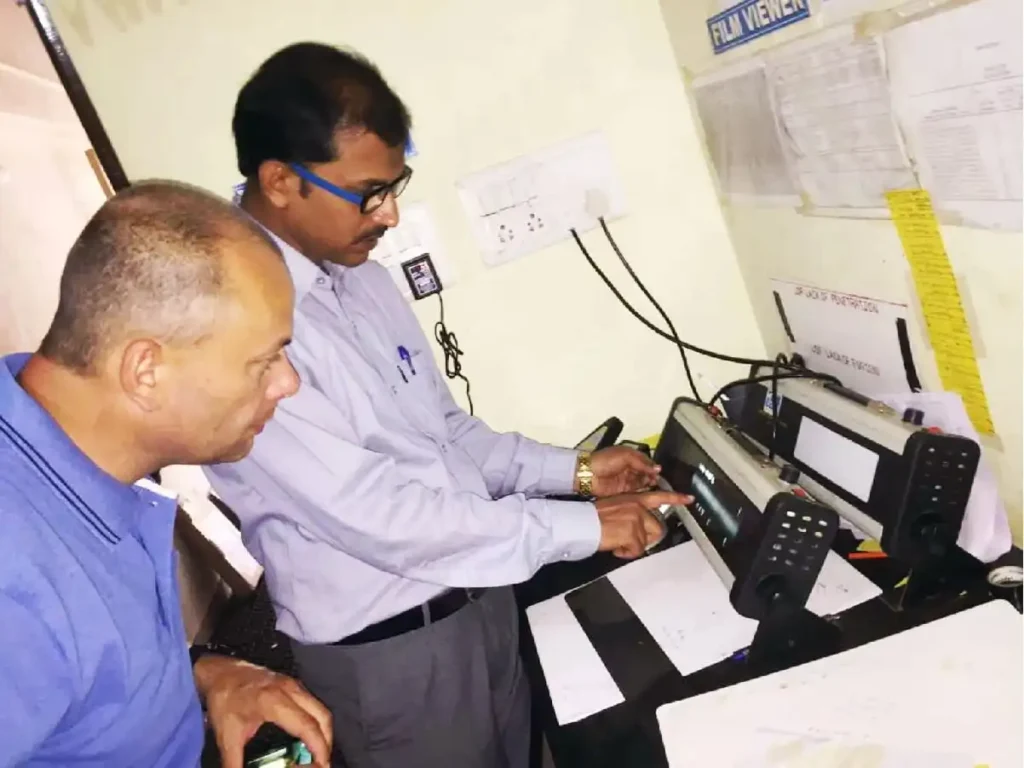
Radiographic Testing (RT) is one of the most technically demanding and most highly valued NDT methods in the world. Used for detecting internal flaws in welds, castings, forgings, pressure vessels, and pipelines. RT requires a thorough understanding of radiation physics, film processing, image interpretation, and strict radiation safety protocols. Usually mandated by the Atomic Energy Regulatory Board (AERB) of India.
Trinity NDT WeldSolutions Pvt Ltd, Bangalore offers RT Level I and Level II certification training at its NABL ISO/IEC 17025:2017 accredited laboratory in Peenya, Bangalore. One of the very few training institutes in India equipped with both a dedicated X-ray enclosure and an active Iridium-192 (Ir-192) Gamma Ray source for hands-on practical sessions. This means trainees learn industrial radiography on the same equipment used in production inspection — not on demonstration simulators.
ASNT & ISO9712 Certified Level III trainers
Courses are conducted by ASNT and ISO9712 Certified Level III certified trainers who are also licensed Radiological Safety Officers (RSO) from AERB/BARC, Mumbai. A critical credential that sets Trinity NDT’s RT training apart from all other institutes in India. The finest experienced trainers with over 30+ Years of Radiography testing experience in castings and weld inspections.
Training is available under two certification schemes — ASNT SNT-TC-1A and ISO 9712 — in both online (live virtual) and offline (in-person at Bangalore) formats. RT course theory sessions held at Aspire Auditorium. Onsite training at your facility is also available anywhere in India.
What No Other RT Training Institute in India Can Offer You
X-Ray Enclosure
Dedicated shielded X-ray room for full practical training on production-grade X-ray equipment (not simulation)
Active Iridium-192 (Ir-192) Gamma Ray Source
Practise actual gamma radiography on real industrial specimens (welds, castings, pipes)
AERB/BARC Licensed RSO In-House
Your trainers are Radiological Safety Officers certified by India's Atomic Energy Regulatory Board — the qualification required to legally operate radiation sources in India
NABL Accredited RT Lab
NABL ISO/IEC 17025:2017 accreditation means every radiograph produced in our lab meets the highest quality standard recognised by all Indian regulatory bodies
Hundreds of Reference Radiographs
Curated collection of weld and casting radiographs from real production inspection — interpret actual defect films, not textbook illustrations
Computed Radiography (CR) & Digital RT
Exposure to modern CR systems used in ASME, API, and aerospace radiography alongside traditional film RT
RT Course Details at a Glance
| Parameter | RT (SNT-TC-1A) Offline |
RT/RTFI (SNT-TC-1A) Online |
ISO 9712 RT Offline |
|---|---|---|---|
| Duration | 4–5 Days | 3–4 Days (Live) | 6–7 Days (ISO 25107) |
| Training Hours | 40 Hours (Level I+II combined) | Theory hours covered | Per ISO 25107 requirements |
| Levels Available | Level I & II | Level II / RTFI | Level I & II |
| Batch Size | Max 15 participants | Max 15 participants | Max 10 participants |
| Practical Equipment | X-Ray enclosure + Ir-192 Gamma source | Theory only (practical on request) | X-Ray enclosure + Ir-192 Gamma source |
| Certificate Issued By | Employer / Trinity NDT | Employer / Trinity NDT | TWI India (ISO 17024) |
| Examiner | Trinity NDT ASNT Level III | Trinity NDT ASNT Level III | TWI India Pvt Ltd (Third Party) |
| Radiation Safety (AERB) | Covered in theory + practical | Covered in theory | Covered per ISO 9712 scope |
| On-site at Your Location | ✅ Pan-India | N/A | ✅ Pan-India |
RT Level I — Theory & Practical Modules
- 🔬 1 — X-Ray setup and exposure on weld specimens in the NABL-accredited X-ray enclosure
- ☢️ 2 — Gamma Ray exposure using Iridium-192 (Ir-192) source on pipe weld specimens
- 🎞️ 3 — Manual film processing in darkroom — developer, stop bath, fixer, wash, dry
- 📐 4 — IQI placement and sensitivity verification on actual production radiographs
- 🔍 5 — Film interpretation: weld discontinuities (porosity, slag, cracks, LF, IP) on 50+ reference films
- 🔍 6 — Film interpretation: casting defects on ASTM E446 and E186 reference radiographs
- 💻 7 — Introduction to Computed Radiography (CR) — digital image reading and processing
- 📄 8 — Report writing: complete RT test report for accept/reject/rework classification
- 📝 9 — Mock examination under exam conditions (full-length written + practical)
Who Can Enrol — Eligibility Requirements
| Criterion | RT Level I (SNT-TC-1A) |
RT Level II (SNT-TC-1A) |
RT Level II (ISO 9712) |
|---|---|---|---|
| Minimum Education | 10th Standard | 10th Standard with experience or Diploma/Graduate in Engineering | Per ISO 9712 Annex A |
| Work Experience Required | 210 Hours | 630 Hours | Per ISO 9712 Annex A (product-form specific) |
| Vision Requirement | Near vision (Jaeger J1) + Colour vision | Near vision + Colour vision | Per ISO 9712 Clause 6 |
| Pre-requisite Course | None | None (combined Level I+II batch) | None for direct Level II entry |
| AERB RSO Course | Required separately to operate radiation sources | Required separately to operate sources | Not part of ISO 9712 scope |
| Best Suited For | Freshers, QC trainees, welders seeking RT exposure | QC Engineers, NDT inspectors, RT technicians | Engineers needing internationally recognised third-party certification |
📌 Important (India-specific): Under AERB (Atomic Energy Regulatory Board) rules, operating a radioactive source (X-ray / Gamma Ray camera) in India requires a separate Radiation Safety Course from BARC/AERB. This is mandatory for Industrial Radiographers operating in India and is separate from the NDT Level I/II certification. Our trainers can guide you on AERB registration. Contact: training@trinityndt.com | +91 98441 29439
Radiography Testing vs Radiography Film interpretation. Which Course Do You Need?
Many candidates confuse RT (Radiographic Testing) and RTFI (Radiographic Film Interpretation). They are different certification tracks serving different job roles. Choose the right one for your career:
RT Level I & II — For Industrial Radiographers
This course is for professionals who set up, expose, and process radiographic films using X-ray or Gamma Ray equipment.
You need RT Level I/II if you:
✅ Operate X-ray machines or Gamma Ray cameras
✅ Set up shooting parameters, IQIs, and technique sheets
✅ Work for an NDT service company performing radiography at client sites
✅ Need to interpret films AND set up the equipment
✅ work in oil & gas, petrochemical, piping, or pressure vessel fabrication
Important: To legally operate radioactive sources in India, you also need an AERB Radiation Safety Course separately from this RT certification.
RTFI Level II — For Film Interpreters & Quality Engineers
This course is for quality engineers and inspectors who interpret radiographic films but do NOT operate the radiation source themselves.
You need RTFI Level II if you/your:
✅ Company outsources radiography to a third party
✅ Review and approve radiographs submitted by radiographers
✅ Work as a QC/QA engineer in a welding fabrication or casting facility
✅ Need to evaluate weld or casting quality from radiographs
✅ Want film interpretation skills without radiation safety exposure
This is a shorter course than full RT Level II, focused entirely on interpretation, evaluation, and reporting.
Important Note - AERB/BARC Radiographer/RSO Certifications
☢️ AERB Radiation Safety — Important Information for Indian Radiographers
In India, operating any X-ray machine or radioactive source (Gamma Ray camera) for industrial radiography requires a separate Radiation Safety Course from AERB (Atomic Energy Regulatory Board) and BARC (Bhabha Atomic Research Centre), Mumbai. This is a legal requirement under the Atomic Energy (Radiation Protection) Rules, 2004.
- AERB Certificate is mandatory to be employed as a licensed Industrial Radiographer in India
- Trinity NDT's RT training covers radiation safety comprehensively to help candidates prepare for the AERB examination
- Our trainers are licensed Radiological Safety Officers (RSO) from AERB/BARC — they guide you through the regulatory pathway
- AERB/BARC courses are conducted separately by BARC, Mumbai — we assist with information and application guidance
- RSO courses are available for senior professionals who supervise radiographic operations
📞 For guidance on AERB registration and RSO courses, call: +91 98441 29439 | email: training@trinityndt.com
Which RT Certification Should You Choose? — ASNT vs ISO 9712
| Factor | ASNT SNT-TC-1A | ISO 9712 |
|---|---|---|
| Certification Type | Employer-based | Third-party independent |
| Best For | Indian industry: oil & gas, power, fabrication, railways, defence | Export companies, EU projects, IBR boilers, international clients |
| International Recognition | Americas, Middle East, India — widely accepted | Europe, UK, global via ISO framework — highest portability |
| Training Hours Required | 40 hours minimum (combined Level I+II) | Per ISO 25107 (product-form specific) |
| Relative Cost | Most affordable | Higher (third-party exam body fee) |
| Certificate Validity | Per employer written practice (3–5 years typical) | 5 years (renewable on evidence of practice) |
| Available at Trinity NDT | ✅ Online & Offline | ✅ Offline Only (RTFI track) |
Why Quality Engineers Across 42 Countries Choose Trinity NDT for RT Training
Live X-Ray Enclosure + Ir-192 Gamma Source
Practise actual industrial radiography on production-grade X-ray and gamma ray equipment. No simulator. No substitute. India's only training institute with both X-ray and active gamma source in one facility.
AERB Licensed RSO Trainers
All RT courses are taught by ASNT Level III certified professionals who are also licensed Radiological Safety Officers (RSO) from AERB/BARC, Mumbai — the highest radiation safety credential in India.
NABL Accredited RT Laboratory
Our radiography lab holds NABL ISO/IEC 17025:2017 accreditation (TC-5934). Every radiograph produced during training is made in a lab meeting the same quality standard as production inspection.
Hundreds of Reference Radiographs
Interpret real defect films from actual production jobs — porosity, slag, cracks, lack of fusion in welds; shrinkage and misruns in castings. Not textbook illustrations — actual production rejects.
ET Rise Top 10 MSME India 2021
Economic Times recognised Trinity NDT as India's 10th best-performing MSME in Industrial & Engineering Services. The only NDT training institute in India with this national recognition.
CR / Digital RT Exposure
Modern radiography is moving to Computed Radiography (CR) and Digital Detector Arrays (DDA). We introduce trainees to CR systems during practical sessions — preparing them for the future of the industry.
Frequently Asked Questions — RT Level I & II Certification Course
RT Level II is for professionals who both set up and operate X-ray/Gamma Ray equipment AND interpret radiographic films. RTFI (Radiographic Film Interpretation) Level II is for quality engineers who interpret radiographic films but do not operate the radiation source. In India, operating any radioactive source requires an additional AERB Radiation Safety Certificate.
Yes. Under the Atomic Energy (Radiation Protection) Rules 2004, any person operating a radioactive source (X-ray machine or gamma ray camera) for industrial purposes in India must hold a valid Radiation Safety Certificate from AERB/BARC, Mumbai.
At Trinity NDT’s NABL-accredited laboratory in Peenya, Bangalore, offline participants get hands-on practice with a dedicated X-ray enclosure (production-grade X-ray machine), an active Iridium-192 (Ir-192) Gamma Ray source on actual weld and casting specimens, manual film processing in a darkroom facility, high-intensity film illuminators for interpretation, and a Computed Radiography (CR) reader for digital image processing.
As per ASNT SNT-TC-1A (2024 edition) Table 6.3, the minimum recommended training hours for RT are: Level I — 40 hours; Level II direct — 80 hours (combined Level I + Level II).
The RTFI (Radiographic Film Interpretation) Level II theory component is fully available in our online live-virtual format. However, the practical component — which requires actual X-ray and gamma ray exposure, film processing, and physical film interpretation — is only available in the offline (Bangalore in-person) mode.
Oil & gas; power generation; shipbuilding and marine; aerospace and defence (HAL, ISRO, DRDO); pressure vessel and heat exchanger manufacturing; structural steel fabrication; railways; nuclear power and almost every manufacturing company.
Three ways: (1) WhatsApp +91 98441 29439 — send your name, preferred scheme (SNT-TC-1A / ISO 9712), mode (online/offline), and preferred month; (2) Online registration form at trinityndt.com/training-register/; (3) Email training@trinityndt.com. Our training coordinator confirms your seat, sends fee details, and dispatches pre-study materials within 24 hours.
Explore Other NDT Certification Courses at Trinity NDT
For information about individual NDT Courses, read details about each method.
You can also download outline for each NDT course.