Professional Radiography Testing Services in Bangalore. AERB, Govt of India Approved Enclosure in Peenya. NABL ISO17025 Accredited Lab. Onsite in Hosur, Mysore.
Fastest RT Services. NABL Accredited, IBR Boiler Inspector Approved Lab. Aerospace Quality X-ray Facility.
Experts in Industrial Radiography (x-ray) of Welds, Castings, PCBs & Assemblies. Serving Customers 24X7.
Radiography Testing Services in Bangalore | NABL Accredited X-Ray Lab
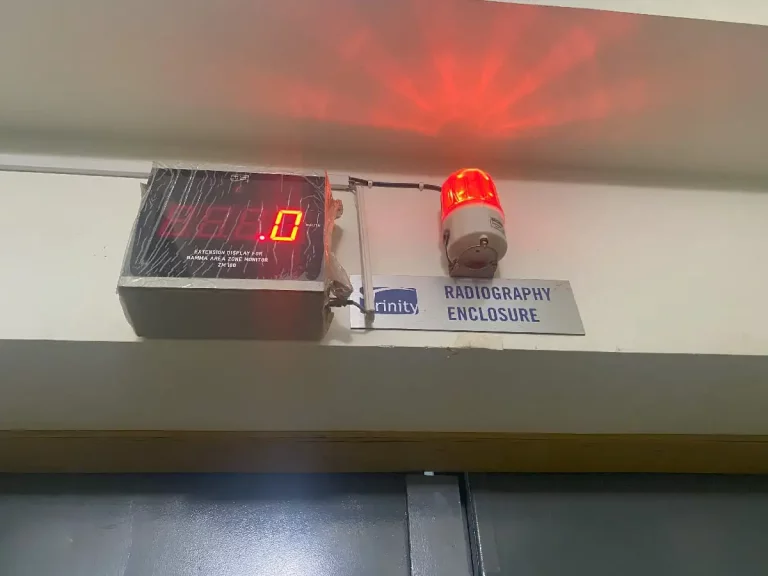
Trinity NDT provides NABL-accredited, AERB-licensed radiography testing (X-ray and Iridium-192 gamma-ray) for welds, castings, pressure vessels and boiler components, in our 24/7 enclosure in Peenya, Bangalore, or on site across Karnataka and India. We are approved by the Directorate of Factories and Boilers, Government of Karnataka, for IBR boiler radiography, and our in-house ASNT Level III and Radiological Safety Officer oversee every job.
- Since 2001, serving 1,500+ customers, with 500+ completed projects
- NABL ISO/IEC 17025:2017 accredited, AERB-licensed 24/7 enclosure, and IBR-approved for boiler radiography
- X-ray up to 250 kV and Iridium-192 sources up to 100 curie, plus film, computed radiography (CR) and digital radiography (DR)
- 5-tonne EOT crane in the enclosure for large castings and welded structures
Get a Quote on WhatsApp Call +91 98441 29439 Download NABL and AERB scope
What Is Radiographic Testing (RT)?
Radiographic testing (RT) is a non-destructive method that passes X-rays or gamma rays through a component onto film or a digital detector, revealing internal flaws such as porosity, slag inclusions, lack of fusion, shrinkage and cracks as differences in image density, because thinner or less dense areas let more radiation through.
RT is one of the few NDT methods that produces a permanent, reviewable record of the internal condition of a weld or casting, which is why many pressure-vessel, pipeline, boiler and aerospace specifications require it. We operate a 24/7 AERB-licensed enclosure in Peenya with a 5-tonne crane, and a mobile team for on-site work.
Radiography testing services at a glance
| Service | What we inspect | Typical standards | Where |
|---|---|---|---|
| RT of weld joints | Pressure vessels, piping, tanks, structures, pipelines | ASME V Art. 2, ISO 17636-1/-2, ISO 10675, AWS D1.1, API 1104 | Lab (enclosure) and on-site |
| RT of castings | Steel and non-ferrous castings, heavy forgings | ASTM E446, E186, IS 2595 | Lab (enclosure) |
| IBR boiler radiography | Boiler headers, economiser tubes, boiler welds | IBR 1950, ASME I | Lab and on-site |
| Film radiography (FR) | Any RT job; preferred for high-contrast, archival records | ASTM E1742, E1032 | Lab and on-site |
| Computed & digital radiography (CR/DR) | Faster, filmless inspection with digital archiving | ASTM E2033, E2698, ISO 17636-2 | Lab and on-site |
Standards shown are examples. We test to your specification, procedure or third-party requirement.
Radiographic Testing of Weld Joints (RT of Welds)
Radiography is the standard volumetric method for weld inspection because it produces a permanent film or digital image that shows internal flaws throughout the weld cross-section, not just along a single scan line. Our radiographers test pressure-vessel, piping, tank, pipeline and structural welds in our enclosure or at your site, using X-ray or Iridium-192 gamma-ray sources depending on material thickness and access.
How weld RT is done
- Select the source (X-ray or Ir-192), technique and source-to-film distance for the joint thickness and geometry
- Place image quality indicators (IQIs) and identification markers on the weld
- Expose the film or digital detector for the calculated time
- Process the film in the dark room, or review the digital image on screen
- Measure film density and IQI sensitivity to confirm image quality
- Interpret indications against the acceptance criteria, then issue the report with the ASNT Level III’s final review
Codes we apply to weld RT
- ASME Section V, Article 2 for the technique, with acceptance from the construction code (for example ASME VIII Division 1)
- ISO 17636-1 (film techniques) and ISO 17636-2 (digital detectors), with ISO 10675-1 giving acceptance levels
- AWS D1.1, API 1104 and customer or third-party specifications
- IS 3600 and IBR 1950 for Indian boiler and pressure work
Radiography shows flaws throughout the weld thickness but cannot give the flaw depth directly the way ultrasonic testing can, and planar flaws such as lack of fusion can be missed if they are not aligned with the beam. Many specifications combine RT with ultrasonic testing or surface methods for full coverage.
Radiographic Testing of Castings (RT of Castings)
Radiography finds internal shrinkage, gas and sand porosity, inclusions and cracks in castings that cannot be seen from outside. Our enclosure, with its 5-tonne EOT crane, lets us radiograph large and heavy castings that many labs cannot handle, and we keep ASTM reference radiographs on hand so indications are classified consistently rather than by individual judgement.
Standards and reference radiographs
- ASTM E446 — reference radiographs for steel castings up to 2 inches (51 mm) thick
- ASTM E186 — reference radiographs for heavy-walled steel castings, 2 to 4½ inches (51 to 114 mm) thick
- IS 2595 — the Indian code of practice for radiographic testing generally, and is used for castings alongside these ASTM references, not as a castings-only standard
- Customer or third-party specification
Our ASNT Level III and ISO 9712 Level 3 -qualified radiographers classify shrinkage, porosity, inclusions and other casting discontinuities against the reference radiographs to give consistent, defensible acceptance decisions.
Film, Computed and Digital Radiography
Film radiography remains the industry standard for high-contrast, archival records on castings, heavy forgings and offshore structures, using AERB-approved X-ray and Iridium-192 sources. We typically use D7 (Agfa) film for standard work and D4 or D3 (Agfa), equivalent to Kodak or Fuji grades, where higher sensitivity is specified. After exposure, films are processed in a dark room with controlled temperature, humidity and chemical concentration, since poor processing creates artefacts that can be mistaken for real indications.
Computed radiography (CR) and digital radiography (DR) use imaging plates or digital detector arrays instead of film, giving results in minutes instead of hours, reduced radiation exposure per exposure, digital archiving and easier remote review, to ISO 17636-2 and ASTM digital-detector standards. We apply CR/DR to aerospace components, pressure vessels and pipeline welds where speed and digital records matter, while keeping film for jobs that call for it.
Computed Radiography (CR) service →
Contact us at +91 98441 29439 or info@trinityndt.com to schedule your radiography inspection.
Codes and Standards for Radiographic Testing
You can choose any recognised standard or supply your own procedure. Our ASNT Level III consultants can prepare and approve an RT procedure for your parts.
| Purpose | Standards | Notes |
|---|---|---|
| General practice (film) | ASTM E1742/E1742M · ASTM E94 (guide) · ASTM E1032 (weldments) | E1742 is the current general practice for film radiographic examination of metallic and non-metallic materials — it is not related to semiconductors |
| Digital detectors | ASTM E2033/E2033M (computed radiography) · ASTM E2698 (digital detector arrays) | Used with CR and DR systems |
| ASME | Section V, Article 2 (RT technique) · Section VIII (pressure vessels) · Section I (power boilers) · B31.1, B31.3 (piping) | Article 2 gives the technique; acceptance comes from the construction code |
| Welds: ISO | ISO 17636-1 (film) · ISO 17636-2 (digital detectors) · ISO 10675-1 (acceptance levels, steel/nickel/titanium) · ISO 10675-2 (aluminium) | 10675 assumes testing was done to 17636-1 or -2 |
| Welds: EN and AWS | EN 1435 · AWS D1.1 (steel) · AWS D1.2 (aluminium) · AWS D1.6 (stainless steel) | — |
| Castings | ASTM E446 (up to 2 in.) · ASTM E186 (2–4½ in.) · ASTM E280 (4½–12 in.) · ASTM E505 (aluminium and magnesium castings) | Reference radiographs for defect classification |
| Pipelines and tanks | API 1104 · API 510 · API 653 | — |
| Indian standards | IS 3600 (welds) · IS 2595 (general code of practice for RT) · IBR 1950 | IS 2595 is not castings-only; it is a general RT code of practice applied to castings among other products |
Standards are revised regularly. Confirm the edition your contract requires, or ask our Level III team.
NABL, AERB and IBR Accreditation, Radiography Personnel and Equipment
| Item | Detail |
|---|---|
| NABL | Accredited to ISO/IEC 17025:2017 for the non-destructive testing discipline. Download the NABL certificate and scope. |
| AERB | Radiography enclosure licensed by the Atomic Energy Regulatory Board (AERB), Mumbai, for Iridium-192 sources up to 100 curie and X-ray up to 250 kV, operating 24/7 with controlled access and interlocks. |
| IBR | Approved by the Directorate of Factories and Boilers, Government of Karnataka, for radiography of boiler components under the Indian Boiler Regulations. |
| Aerospace | Our aerospace division holds separate NADCAP accreditation for MPI and FPI; radiography quality on aerospace components is controlled to the same rigour under NABL. Aerospace NDT services → |
| Radiographers | BARC-certified Level I radiographers, with in-house ASNT Level III and a certified Radiological Safety Officer (RSO), all AERB-registered |
| Equipment | Iridium-192 radiography cameras (IGRED), 250 kV X-ray machine, radiography enclosure with 5-tonne EOT crane, radiation survey meters (calibrated annually), pocket dosimeters, IQIs, film processing dark room, CR equipment |
| Safety | Personal dosimeters for all RT personnel, controlled-access enclosure with interlocks, regular AERB audits and compliance reviews, and radiation-safety training for all radiographers |
AERB Licensed RT Enclosure
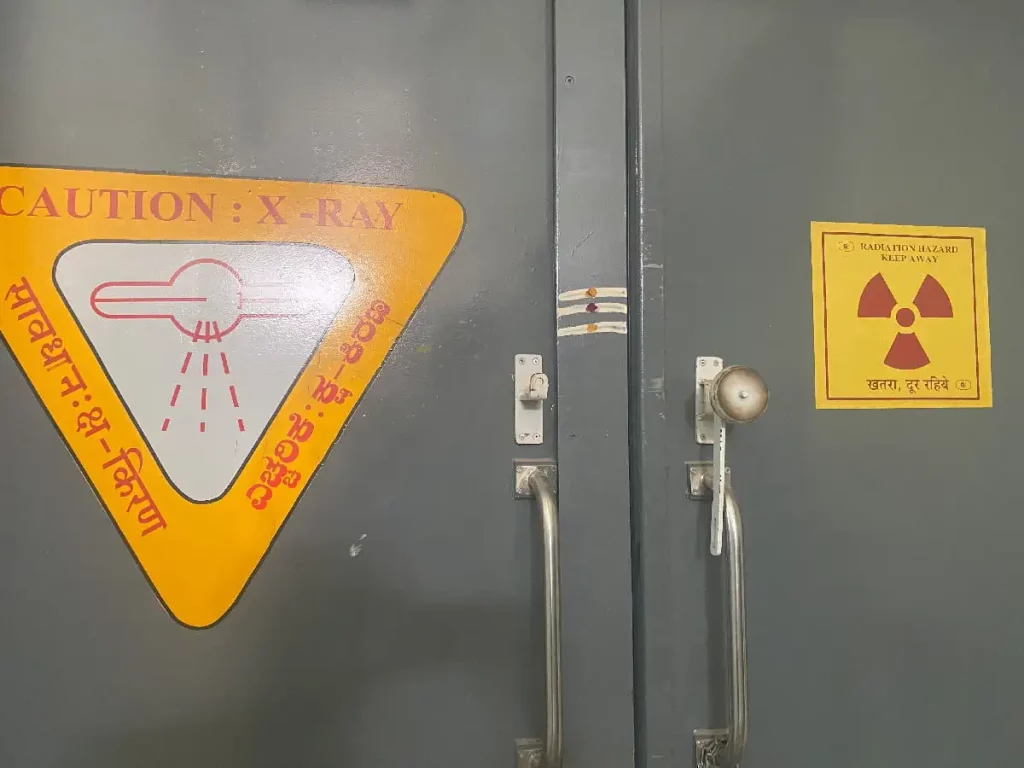
Designed to meet requirements of AERB, it is one of the best Radiography testing enclosure located at Peenya, Bangalore. Enclosure can operate up to 100 Curie of Iridium192 source. Cameras carry sources under safe conditions. X-rays provides superior quality images.
With built in radiation safety, it is one of the finest Radiography X ray center in India. Serving not only customers in Bangalore, but also in Hosur and Mysore.
On-Site Radiography Services Across Karnataka and India
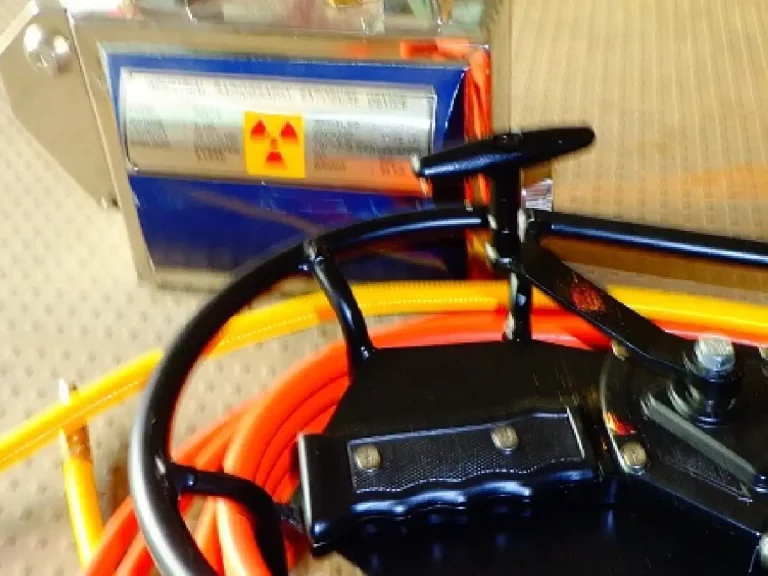
Large welded structures, fabricated assemblies, pipeline welds, tanks, pressure vessels and oversized castings often cannot be brought to our Peenya enclosure. Since transporting radiation sources needs prior AERB clearance, on-site jobs go through a feasibility check and approval by our Radiological Safety Officer and AERB, Mumbai, before we mobilise a mobile team with portable equipment and full safety gear.
We serve Bangalore, Hosur, Mysuru and locations across India. Request an on-site feasibility check on WhatsApp
Industries We Serve with RT Testing
Aerospace & Defense
Aircraft components, engine parts, structural elements requiring NADCAP-level quality
Oil & Gas
Pipeline welds, pressure vessels, storage tanks, refinery equipment per API standards
Power Generation
Boiler tubes, turbine components, pressure parts, critical welds per ASME codes
Automotive
Aluminum castings, engine blocks, transmission housings, safety-critical components
Manufacturing
Heavy machinery castings, forgings, fabricated structures, general engineering components
Construction & Infrastructure
Structural steel welds, bridge components, building frames per AWS D1.1
Process, Quality Control and Report Contents
Pre-exposure checks
IQI selection and verification, film or detector selection, exposure calculation, and equipment calibration.
During exposure
Correct source-to-film distance, exposure time, radiation monitoring and control of environmental conditions.
Post-exposure quality checks
Film density measurement, IQI sensitivity (2-2T minimum unless otherwise specified), image quality review, artefact-free processing, and final review by our in-house ASNT Level III, who also prepares and approves written procedures, acceptance criteria and technique selection as company Level III under ASNT SNT-TC-1A.
What is in our RT report
- Customer, job and part identification, material and thickness
- Standard, procedure number and acceptance criteria applied
- Source type (X-ray kV or Ir-192), technique, source-to-film distance and exposure details
- Film type and IQI sensitivity achieved, or digital detector details for CR/DR
- Location and classification of each recordable indication
- Accept or reject evaluation, radiographer name and certification level, with Level III approval
What Radiographic Testing Can and Cannot Detect
RT is highly effective at finding volumetric flaws such as porosity, slag inclusions, shrinkage and gas cavities, because these show as clear density changes on the image. It is less reliable for planar flaws such as cracks and lack of fusion when they are not aligned with the radiation beam, and it does not give flaw depth directly, unlike ultrasonic testing. RT needs access to both sides of the component (source on one side, film or detector on the other), involves ionising radiation with strict safety controls, and film processing adds time compared with real-time methods.
RT compared with other volumetric and surface methods
| Feature | Radiography (RT) | Ultrasonic (UT) | Magnetic particle (MT) | Penetrant (PT) |
|---|---|---|---|---|
| Internal flaws | Yes | Yes | No | No |
| Flaw depth | Not directly | Yes | No | No |
| Permanent record | Yes (film or digital image) | With digital equipment | Photograph only | Photograph only |
| Access needed | Both sides | One side (pulse-echo) | Surface | Surface |
| Radiation hazard | Yes — licensed and controlled | None | None | None |
| Best for | Castings, complex geometry, volumetric records | Welds, forgings, thickness, flaw sizing | Surface cracks on ferromagnetic material | Surface cracks on non-porous material |
Not sure which method your specification needs? Ask our ASNT Level III team.
Why Customers Choose Trinity NDT for Radiography Testing
- Triple compliance. NABL ISO/IEC 17025:2017, AERB licensing and IBR approval together, so one lab covers accreditation, radiation safety and boiler compliance.
- 24/7 AERB-licensed enclosure with a 5-tonne EOT crane, for components other labs cannot handle.
- In-house ASNT Level III and a certified Radiological Safety Officer, with no outsourced interpretation or safety oversight.
- Film, CR and DR under one roof, so you choose the technology that fits your job.
- Mobile on-site capability with AERB-approved portable equipment across Karnataka and India.
- 25 years of experience since 2001, across aerospace, oil and gas, power generation, automotive, manufacturing and construction.
How to choose a radiography testing lab: checklist
- Is the enclosure AERB-licensed, and is a Radiological Safety Officer on site?
- Does the NABL scope cover the source type, technique and standard you need?
- Who reviews the radiographs: are Level II radiographers backed by an in-house Level III?
- Can the lab handle your part size and weight (crane capacity, enclosure dimensions)?
- Does the lab offer both film and digital (CR/DR), or only one?
- Will the report state the source, technique, IQI sensitivity and every recorded indication?
- Can the lab mobilise on site, and how is AERB approval for on-site work handled?
NABL Accredited
ISO 17025:2017 certified laboratory with internationally recognized test reports
24/7 Availability
Round-the-clock RT enclosure operations for urgent testing needs
1,500+ Happy Clients
Trusted by industries across India since 2001
AERB Licensed
Government of India-approved RT facility with certified RSO on-site
State-of-the-Art RT Enclosure in Peenya
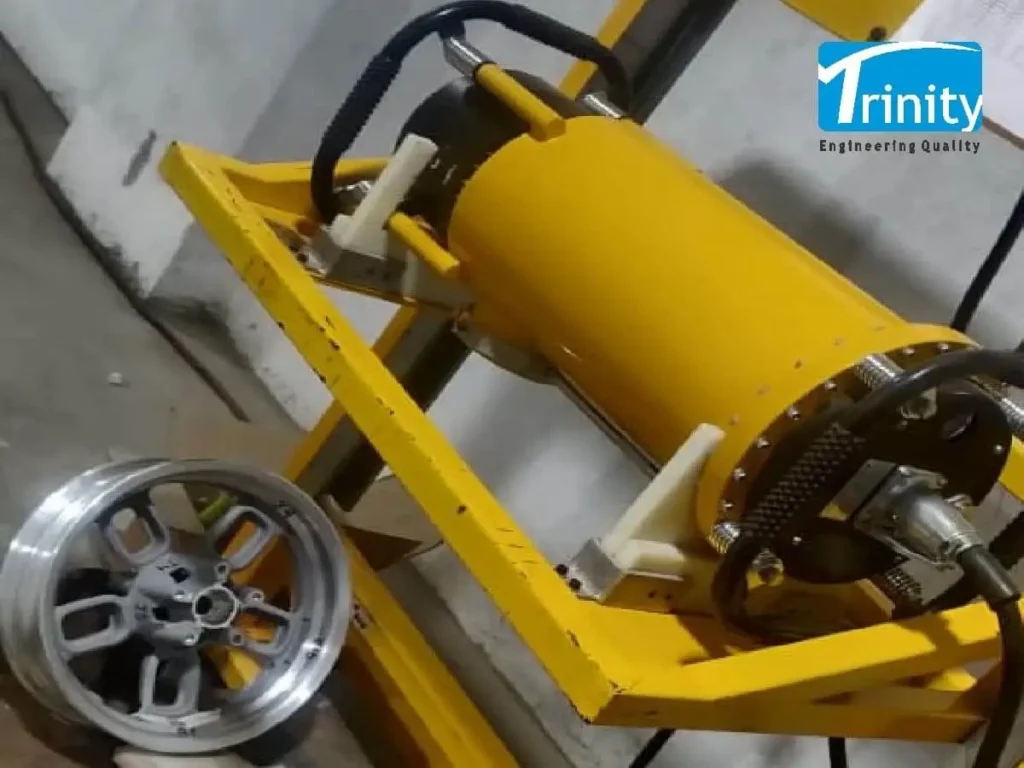
Radiography enclosures provide the safest environment for X-ray inspections. Since transporting radiation sources requires prior AERB approval, in-house enclosures offer a practical solution when components cannot be moved to testing sites. Enclosure eliminates these logistical challenges while maintaining the highest safety standards.
Trinity NDT – RT Enclosure at Bangalore is operational 24X7. Facility approved by Atomic Energy Regulatory Board (AERB) Mumbai.
What Sets Trinity NDT’s RT Lab Apart from Others
Precision, compliance, and reliability — engineered into every radiographic test we perform.
Largest RT Enclosure in Bangalore
100 Curie capacity, 5-tonne crane - handle components others can't
True 24/7 Operations
Not just "on-call" - fully staffed round-the-clock operations for urgent needs
Triple Accreditation
NABL + AERB + IBR = comprehensive compliance coverage
In-House ASNT Level III
Immediate expert consultation, no outsourcing for interpretation
Advanced Technology Mix
Film + CR + DR options - choose what's best for your application
25+ Years RSO Experience
Not just certified - decades of practical radiation safety expertise
Mobile RT Capability
Full on-site services with AERB-approved portable equipment
Industry-Specific Expertise
Aerospace to boilers - we understand your specific code requirements
Request a Radiography Testing Quotation
Send the drawing, material, quantity and standard and we will confirm the technique and price.
WhatsApp: +91 98441 29439 Call +91 98441 29439 info@trinityndt.com
Trinity NDT WeldSolutions Private Limited
491, Site No. 12, 14th Cross, 4th Phase, Peenya Industrial Area, Bangalore 560058, Karnataka, India
Technically reviewed by Ravi Kumar T, CEO and Co-Founder, Trinity NDT WeldSolutions Pvt. Ltd. (ASNT NDT Level III in six NDT methods, International Welding Engineer). Last reviewed: 22 September 2026. Standards references are checked against ASTM, ASME and ISO publications. Always confirm the edition your contract requires.
Frequently Asked Questions About Radiographic Testing
Radiographic testing (RT) is a non-destructive method that passes X-rays or gamma rays through a component onto film or a digital detector. Internal flaws such as porosity, slag inclusions, lack of fusion and shrinkage show up as differences in image density, because thinner or less dense areas let more radiation through. RT gives a permanent, reviewable record of the internal condition of a weld or casting.
Yes, Trinity NDT’s radiography testing laboratory is accredited by NABL to ISO/IEC 17025:2017. This ensures our test reports are internationally recognised. You can download our NABL certificate and scope from our website.
Yes. Our radiography enclosure in Peenya, Bangalore is licensed by the Atomic Energy Regulatory Board (AERB), Mumbai, and operates 24/7 with a certified Radiological Safety Officer on site, controlled access, interlocks and regular AERB audits.
Yes. Our mobile RT teams provide on-site X-ray and gamma-ray testing across Karnataka, including Bangalore, Hosur and Mysuru, and elsewhere in India for larger projects. On-site jobs go through a feasibility check and AERB approval before mobilisation, since moving radiation sources requires prior clearance.
X-ray radiography uses an electrically generated beam with adjustable energy, suited to thinner materials, and can be switched off when not exposing. Gamma-ray radiography uses a radioactive isotope such as Iridium-192, which is always emitting, is more portable, and is often used for thicker materials or where a power supply is not available on site.
RT is most effective at finding volumetric flaws that show as a clear change in image density: porosity, slag inclusions, shrinkage, gas cavities and lack of penetration. It can also detect cracks and lack of fusion, but is less reliable for these planar flaws when they are not aligned with the radiation beam, so RT is often combined with ultrasonic or surface testing for full coverage.
Image quality indicators (IQIs) and markers are placed on the weld, then the film or digital detector is exposed to the calculated source-to-film distance and exposure time. The film is processed or the digital image reviewed, film density and IQI sensitivity are checked, and indications are interpreted against the acceptance criteria. Common standards are ASME Section V Article 2, ISO 17636-1 or -2, ISO 10675, AWS D1.1 and API 1104.
Castings are radiographed to reveal internal shrinkage, porosity, inclusions and cracks, and indications are classified against reference radiographs rather than by individual judgement. Common standards are ASTM E446 for steel castings up to 2 inches thick and ASTM E186 for heavy-walled castings from 2 to 4.5 inches, alongside IS 2595, the Indian code of practice for radiographic testing generally.
Film radiography exposes industrial X-ray film, which is then chemically processed in a dark room; it remains the standard for high-contrast, archival images on castings and heavy sections. Computed radiography (CR) and digital radiography (DR) use imaging plates or digital detectors instead, giving results in minutes rather than hours, digital archiving and easier remote review, following ISO 17636-2 and the relevant ASTM digital-detector practices.
Yes. Trinity NDT is approved by the Directorate of Factories and Boilers, Government of Karnataka, as per the Indian Boiler Regulations (IBR), for radiography of boiler headers, economiser tubes and boiler welds. We also support IBR welder qualification through our welding centre.
Yes. Radiography for aerospace components is carried out under the same NABL-accredited quality system, with in-house ASNT Level III review. Our aerospace division separately holds NADCAP accreditation for magnetic particle and fluorescent penetrant inspection; contact us to confirm the specific accreditation status relevant to your aerospace radiography requirement.
An image quality indicator (IQI), also called a penetrameter, is a device placed on the component during exposure to confirm the radiograph can show flaws of a defined size. Sensitivity is usually expressed as a percentage, for example 2-2T, meaning a wire or hole of that reference size is visible on the image. Our standard sensitivity is 2-2T; higher sensitivity can be specified where the standard requires it.
In-house testing is typically same-day to 24 hours for film, and a few minutes to review once exposed for digital radiography. On-site testing usually takes 1 to 3 days including travel, feasibility checks and setup. Larger or more complex castings may take 24 to 72 hours depending on size and film quality required. Contact us with your job details for an accurate turnaround estimate.
RT testing costs depend on material, component thickness, film quality, sensitivity level and testing location. For a standard weld coupon of 300 mm length and up to 10 mm thickness, charges start from Rs 750 plus GST. Casting and on-site charges vary with size and weight. Contact us on WhatsApp with your job details for an accurate quotation.
Yes. We operate computed radiography (CR) and digital radiography (DR) systems alongside film at our Peenya facility. Digital radiography typically gives results within minutes of exposure, compared with roughly two to four hours for film processing, along with digital archiving and easier remote review.
Send the component description and size, material and thickness, drawing or technical specification if available, job location and quantity, the applicable standard (ASME, ASTM, AWS or similar), and your RT procedure or acceptance criteria if you have one. We typically respond with a quotation within two hours during business days.
Our RT report states the customer, job and part identification, material and thickness, the standard and acceptance criteria applied, source type and exposure details, film type or digital detector information, IQI sensitivity achieved, the location and classification of each recordable indication, the accept or reject evaluation, and the radiographer’s certification level with Level III approval.
You can drop components at our Peenya facility, which is open 24/7, arrange courier or transport to our lab, request pickup within the Bangalore region, or schedule on-site testing if components are too large to move. Send us the component details on WhatsApp first so we can advise the best option and quote accurately.
A certified Radiological Safety Officer is on site, all RT personnel use personal dosimeters and undergo radiation-safety training and health monitoring, radiation survey meters are calibrated annually, the enclosure has controlled access with interlocks, and the facility undergoes regular AERB audits and compliance reviews, following the AERB Safety Code for Industrial Radiography and the Radiation Protection Rules.
No single method finds every defect. RT is strong on volumetric flaws such as porosity and shrinkage, but is less reliable for tight cracks or lack of fusion that are not aligned with the beam, and it does not give flaw depth directly. Surface-breaking flaws are better found with magnetic particle or penetrant testing, and precise flaw sizing is better done with ultrasonic testing. We can advise which combination of methods fits your specification.
Dark Room Film Processing Facility
Digital imaging is picking up at a faster pace using DR, Computed Radiography services However, film radiography is dominant in industrial applications. After exposure, x ray films shall be processed in a dark room. Using right temperature, humidity and chemicals.
Improper film processing can create film artifacts that appear as false indications, compromising test accuracy. That’s why skilled RT technicians meticulously control temperature, humidity, and chemical concentrations during film processing. This attention to detail ensures consistent, reliable results you can trust.
Selection of X ray film quality depends on customer needs. In general, we prefer using D7 (Agfa Make) films. Based on customer need, we can also use other quality x ray films such as D4 or D3 (Agfa make) equivalent of Kodak or Fuji.
Whether you need rapid digital reports for urgent shutdowns or archival film records for regulatory compliance, Trinity NDT delivers reliable, cost-effective radiography solutions across Peenya, Bengaluru. Contact us at +919844129439 or info@trinityndt.com to schedule your radiography inspection today.
ASTM E446 Casting Reference Radiographs Available for Interpretation
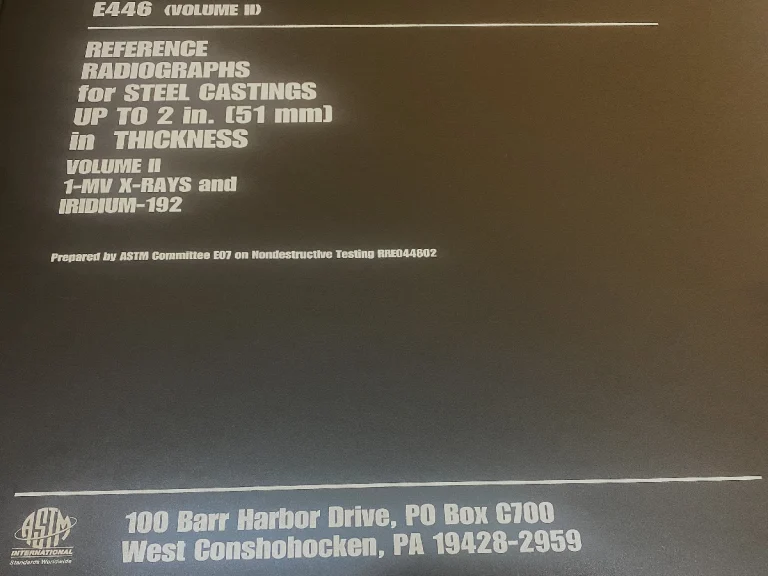
With decades of experience, BARC Level I Radiographers can do inspection of heavy castings and welds. For X ray film interpretation of castings ASTM E446 reference Radiographs are available at labs. Similarly, Welding Radiography reference standards are available for weld x-ray interpretation.
These ASTM E446 reference radiographs are published from ASTM, USA. Standard helps in classification of shrinkage levels, defects in castings. ASNT Level III experts and ISO9712 certified Level 3s perform interpretation as per the standard.
ASNT Level III Expert Supervision
Radiography test results are reliable under able guidance of ASNT Level III & ISO 9712 Level III experts. Our in-house RT Level 3 prepares, approves NDT procedures. Supports customers as company level III as per ASNT SNT TC 1A. Preparation of written practice for employers for qualification, certification of NDT personnel. Even for selection of technique, acceptance criteria. In-house expert stationed at Bangalore, adds great value for quality of x-ray services. Check profile of Ravi Kumar Thammana, ASNT Level III.
If you need ASNT Level III consulting on Radiography method at Bangalore, contact us. Know more about ASNT NDT Level III Services.
For helping customers in establishing right NDT procedure, we have published free Radiography testing procedure pdf to download.
Personnel Safety: All radiographers undergo comprehensive radiation safety training and health monitoring per AERB requirements. Our safety record is impeccable with zero radiation incidents since 2001 per monitoring reports available at elora portal of AERB, Govt. of India.
Radiography Testing Equipment & Capabilities
The Radiography testing labs at Bangalore Karnataka, India has
- Ir-192 Radiography Cameras(IGRED)
- X-Ray machine – 250Kv
- Radiography Enclosure
- Radiation Survey Meters
- Pocket Dosimeters
- Safety Accessories CV Tongs, Lead Pots & Lead Sheets
- IQI Image Quality Indicators
- Computed Radiography Equipment
- Film Processing Dark Room
RT Testing Pricing & Contact Information
Radiography testing costs depend on several factors including material type, component thickness, X-ray film quality, and required sensitivity levels. We use D4 grade film for high-quality applications and D7 for standard inspections. Typical sensitivity requirements are 2-2T per industry standards. For a standard weld test coupon (300mm length, 10mm thickness), our RT services start from ₹750 + GST. Contact us via WhatsApp for a detailed quotation tailored to your specific requirements.
X ray radiography test charges are based on film consumption and location of testing. In general, for a weld test coupon of 300mm length, 10mm thickness radiography our charges starts from Rs.750/-+gst. For quotation for RT services in Bangalore, WhatsApp us your request or Call us now on +919844129439. Email: info@trinityndt.com
Radiography Testing Services in Bangalore. Pricing Guide.
| Service Type | Material Thickness | Starting Price | Turnaround Time |
|---|---|---|---|
| RT Testing for Welds (300mm) | Up to 10mm | ₹750 + GST | 24 hours |
| Weld RT Testing (300mm) | 10mm - 25mm | ₹1,200 + GST | 24 hours |
| Casting RT Inspection | Small (up to 5kg) | ₹1,500 + GST | 24-48 hours |
| RT Inspection for Castings | Medium (5-20kg) | ₹2,500 + GST | 48-72 hours |
| Digital Radiography | Per exposure | Contact us | Same day |
| On-Site RT Services | Per day | ₹8,000 + GST for Local. For Out station contact us | As per schedule |
| IBR Boiler Inspection | Per component | Contact us | 24-48 hours |
Pricing Notes: Tentative Price for Indication only. Contact Trinity NDT with job details, specifications to get accurate pricing based on above factors.
– Film quality: D7 (standard) or D4 (high quality) – affects pricing
– Sensitivity: 2-2T is standard; higher sensitivity increases cost
– Volume discounts available for bulk orders
– On-site RT testing charges in and around Bangalore City within 20km radius
WhatsApp us your requirements or Email: info@trinityndt.com
How to Get Started?
Getting started with our RT services is simple. Send us a WhatsApp message with the following details:
- Component description and size
- Material specification and thickness
- Drawing or technical specifications (if available)
- Job location and quantity (number of welds/castings)
- Applicable testing standard (ASME, ASTM, AWS, etc.)
- RT procedure and acceptance criteria (if specified)
- Your contact information
‘Trinity NDT’ technical team typically responds within 2 hours during business days with a comprehensive quotation.
Note: Tentative Price for Indication only. Contact Trinity NDT with job details, specifications to get accurate pricing based on above factors
Training Opportunities:
If you’re interested in RT career but not yet qualified:
→ RT Level II Training Program
→ BARC Radiographer Course Guidance