
Eddy Current Testing Training (ET) Level I & II Certification Course
India's Most Technically Advanced ET Training — From Impedance Plane Theory to Real Tube & Aerospace Practicals ASNT SNT-TC-1A · ISO 9712 · Online & Offline · Bangalore
- 🏆NABL ISO17025 Accredited ET Lab
- ✈️Aerospace & NAS 410 Scope
- 🔬Heat Exchanger Tube Practicals
- 🌍45+ Countries Represented



Eddy Current Testing Training Level I, II Certification
Eddy Current Testing training (ET) for Level I, II certification is the most technically sophisticated of the six conventional NDT methods. And is one of the most valuable technique. Unlike surface methods such as Magnetic Particle Testing or Liquid Penetrant Testing, ET can detect both surface and subsurface discontinuities without direct contact with the test material. It requires only that the test material be electrically conductive.
The physical principle is straightforward: an alternating current passed through a coil creates a changing magnetic field that induces eddy currents in the conductive material beneath. Any discontinuity, dimensional change, or variation in material properties — corrosion, cracking, conductivity change, permeability variation — distorts the eddy current flow and produces a measurable change in coil impedance. The skilled ET technician reads this change on an impedance plane display and interprets the nature, size, and depth of the indication.
Eddy Current Testing Training for Level I, II Certification- Choice of 3 Critical Applications.
In practice, ET is the method of choice for three critical inspection applications:
1. Heat Exchanger Tube Inspection — the most widely used application in petroleum refineries, power plants, and process industries. ET inspects hundreds of tubes per day non-destructively, detecting wall thinning, pitting, circumferential cracking, baffle plate wear, and deposits without removing tubes from service.
2. Aerospace Surface Crack Detection — scanning aluminium airframe panels, fastener holes, engine components, and landing gear for fatigue cracks. In aerospace, ET is the primary surface crack method for non-ferromagnetic alloys where MT cannot be applied.
3. Material Sorting & Coating Thickness — verifying alloy grade, hardness, and heat treatment condition; measuring paint/coating thickness on conductive substrates.
ISO17025 Accredited Labs for Eddy Current Testing Training - Level I, II Practical Sessions
Trinity NDT WeldSolutions offers Eddy Current testing training for Level I and Level II certification at its NABL ISO/IEC 17025:2017 accredited laboratory in Peenya, Bangalore. Equipped with professional Eddy Current instruments for heat exchanger tube testing, surface scanning, and material sorting practicals. All ET courses are delivered by ASNT Level III and NAS 410 Level III certified instructors with over 28 years of hands-on ET experience across petrochemical, aerospace, and automotive sectors.
Courses are available under ASNT SNT-TC-1A and ISO 9712 certification schemes, in both online (live virtual) and offline (in-person at Bangalore) formats.
Eddy Current Testing Techniques — What You Will Learn to Master
Unlike other NDT methods where one technique covers most applications, Eddy Current testing training has five distinct techniques — each designed for a specific inspection challenge. Trinity NDT’s ET Level II course covers all five, giving graduates the broadest and most practical ET skill set available in India.
1. Conventional ET (CET) — Surface & Near-Surface Crack Detection
The fundamental eddy current technique — used for detecting surface-breaking and near-surface cracks in non-ferromagnetic materials (aluminium alloys, titanium, stainless steel, copper alloys, brass, bronze).
Primary applications:
– Aerospace aluminium panel and fastener hole crack inspection
– Turbine blade and disc inspection (aerospace MRO)
– Stainless steel tube weld seam inspection
– Pipe and tube external surface crack detection
Equipment: Single-frequency impedance plane instrument; absolute or differential surface probes.
Codes & Standards: ASTM E426, ASTM E243, NAS 410 (aerospace), ASME Section V Article 8.
2. Eddy Current Testing Ferromagnetic Tube Inspection
Conventional ET cannot effectively inspect carbon steel, low-alloy steel, or cast iron tubes because the high magnetic permeability of ferromagnetic materials severely limits eddy current penetration depth. This limitation using a specially designed exciter coil and remote detector coil arrangement that provides full-wall penetration of ferromagnetic tubes.
Primary applications:
– Carbon steel boiler tubes
– Cast iron water mains
– Low alloy steel heat exchanger tubes in boilers
– Gas plant carbon steel tubes
What the technique detects: Wall thinning, corrosion, pitting, and erosion through the full tube wall.
Note: A specialist technique covered in the advanced ET module of Trinity NDT’s ET Level II course.
3. Material Sorting & Conductivity Measurement
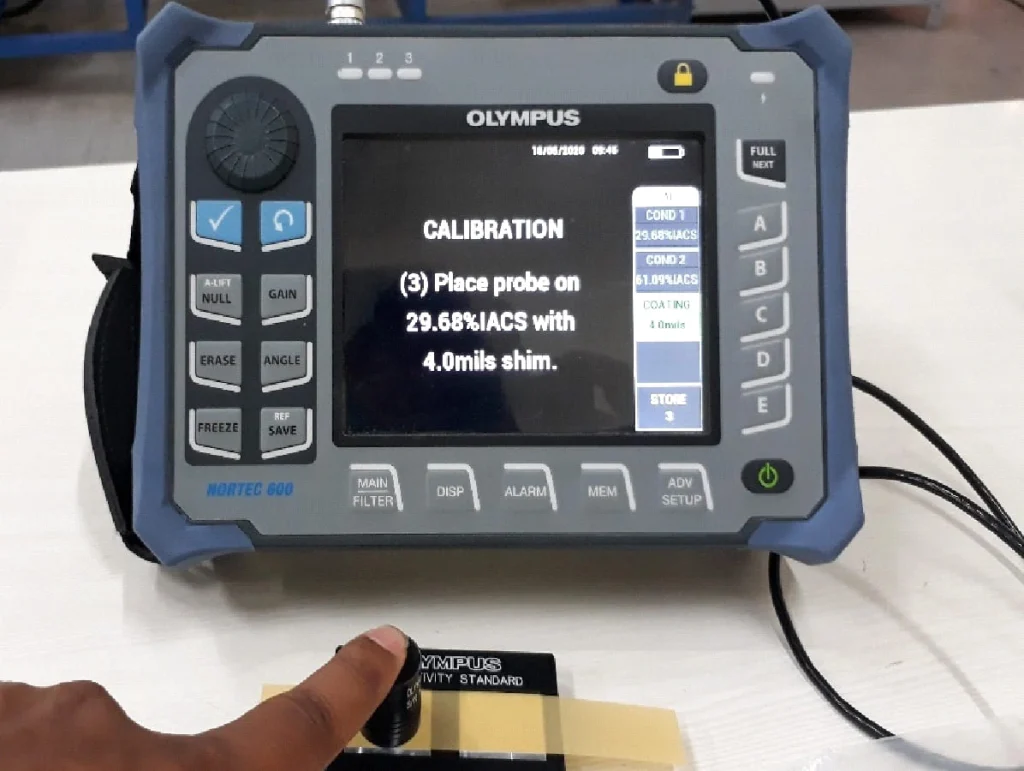
Eddy current conductivity measurement (in % IACS — International Annealed Copper Standard) is used to sort mixed alloys, verify heat treatment condition, and detect in-service damage from overheating.
Primary applications:
– Alloy sorting — distinguishing between similar-appearing alloys (e.g., 6061 vs 7075 aluminium; Grade 304 vs 316 stainless steel)
– Heat treatment verification — comparing conductivity to known reference value
– Detecting overheating/overstress in aluminium aerospace components (changes permeability)
– Sorting mixed components in CNC shops and foundries
– Coating thickness measurement on conductive substrates
Equipment: Portable conductivity meter (Sigmatest, Hocking Autosigma); values reported in % IACS or MS/m.
Eddy Current testing Training Course Details - at a Glance
| Parameter | ET (SNT-TC-1A) Offline |
ET (SNT-TC-1A) Online |
ISO 9712 ET Offline |
|---|---|---|---|
| Duration | 5 Days (40 Hours) | 4–5 Days (Live Online) | 6–7 Days (per ISO 25107) |
| Training Hours Required | 40 hrs (Level I+II combined) 80 hrs if direct Level II |
40 hrs theory (Level I+II combined) | Per ISO 25107 (product-form specific) |
| Levels Available | Level I & II (combined) | Level II | Level I & II |
| Batch Size | Max 10 participants | Max 12 participants | Max 8 participants |
| Practical Equipment | EC instrument + surface probes + tube testing kit + material sorting probes | Theory only (practical add-on at Bangalore) | EC instrument + probes + NABL lab specimens |
| Techniques Covered | CET, Tube ET, Material Sorting, RFET intro, ECA intro | All theory topics | Per chosen product form (Tubes / Welds / Sheets) |
| Certificate Issued By | Employer / Trinity NDT | Employer / Trinity NDT | TWI India Pvt Ltd (ISO 17024) |
| OJT Hours (SNT-TC-1A) | 630 hrs min (Level II direct) per SNT-TC-1A Table 6.3 | Same requirement applies post-training | Per ISO 9712 Annex A (product-form) |
| Onsite at Your Location | ✅ Pan-India | N/A | ✅ Pan-India |
📌 SNT-TC-1A Training Hours Clarification: If a candidate attends Level II directly (without prior Level I training), the minimum classroom training required is 80 hours for ET. If the candidate has completed Level I training (40 hours) and then upgrades to Level II, only an additional 40 hours is required. Trinity NDT offers an intensive combined Level I+II programme covering the minimum 40-hour requirement. Contact us to plan a training sequence that meets your employer’s Written Practice requirements.
Eligibility Requirements — Who Can Enrol?
| Criterion | ET Level I (SNT-TC-1A) |
ET Level II (SNT-TC-1A) |
ET Level II (ISO 9712) |
|---|---|---|---|
| Minimum Education | 10th Standard | 10th Standard | Per ISO 9712 Annex A |
| Work Experience | 200 Hours | 630 Hours (OJT required for certification) | Per ISO 9712 Annex A (method + product form) |
| OJT Hours (SNT-TC-1A) | 200 hours minimum | 630 hours minimum (direct Level II) | Per ISO 9712 Annex A |
| Vision Requirement | Near vision (Jaeger J1) + Colour vision | Near vision + Colour vision | Per ISO 9712 Clause 6 |
| Prerequisite | None | None (combined Level I+II batch available) | None for direct Level 2 entry |
| Best Suited For | Freshers entering petrochemical or aerospace inspection | QC engineers, heat exchanger maintenance engineers, NDT technicians, aerospace MRO inspectors | Engineers needing internationally portable ISO-certified ET credential for European or international clients |
Which ET Certification Should You Choose? — ASNT vs ISO 9712
| Factor | ASNT SNT-TC-1A | ISO 9712 |
|---|---|---|
| Type | Employer-based | Third-party independent |
| Best For | Indian refineries, power plants, aerospace, petrochemical | Export-oriented companies, EU clients, international EPC projects |
| Product Form Options | General scope | Tubes, Welds, Sheets, Bars — choose your specific scope |
| International Recognition | Americas, Middle East, India — widely accepted | Europe, global via ISO framework |
| Certificate Validity | Per employer written practice (3–5 years typical) | 5 years (renewable on evidence of practice) |
| Relative Cost | Most affordable | Higher (third-party exam body fee) |
| Available at Trinity NDT | ✅ Online & Offline | ✅ Offline Only |
Why Engineers from 45+ Countries Choose Trinity NDT for Eddy Current testing Training?
Real Heat Exchanger Tube Practicals
You will insert an actual bobbin probe into a real tube mock-up specimen and interpret live ET signals — not just look at screenshots in a PDF. Trinity NDT's ET lab is equipped with professional eddy current instruments for tube testing, surface scanning, and conductivity measurement.
ASNT Level III & NAS 410 Level III Trainers
ET is the most technically complex NDT method. Having an ASNT Level III with actual field experience in heat exchanger tube testing and aerospace surface scanning makes an enormous difference to learning quality — and to exam success.
Impedance Plane Mastery — Not Just Theory
Most institutes teach the impedance plane from textbook diagrams. Trinity NDT trainers explain impedance plane analysis from real instrument displays, using actual inspection scenarios from petrochemical, power plant, and aerospace jobs. This is the core skill that separates a capable ET Level II from an average one.
India's Only NABL + NADCAP Lab for ET Training
All ET practicals are conducted in our NABL ISO/IEC 17025:2017 accredited laboratory. The NADCAP aerospace accreditation demonstrates the lab operates at the highest global quality standard. Trainees practice ET in a quality-certified environment — not a classroom workshop.
On-Site ET Training — Pan India
Cannot attend Bangalore? Our ASNT Level III ET trainers travel to your facility. We have conducted ET training at refineries in Mumbai, Chennai, Vizag, Kochi, Hyderabad, and Delhi. Minimum 6 candidates for on-site batch. Contact us for a quote.
16,000+ Certified — 45+ Countries
Petrochemical companies from Nigeria, Kenya, Cameron and Ghana; aerospace MRO companies from UAE and Saudi Arabia; power plant operators from India — all trust Trinity NDT for ET certification. Our international network gives you references in your target market.
Where ET Level II Certified Inspectors Work — Key Industries
EPC, Infrastructure & Pipeline Inspection
Weld inspection on stainless steel and non-ferrous alloy pipelines; corrosion assessment on structural steel components; inspection of tubes in air coolers and condensers on pipeline compressor stations.
Aerospace & Defence (HAL, ISRO, DRDO, MRO)
Surface crack detection on aluminium airframes, fastener holes, engine components; disc and blade inspection on turbines. NAS 410 ET Level II is required for aerospace approvals including NADCAP.
Petroleum Refineries & Chemical Plants
Heat exchanger tube inspection during turnarounds — the single largest ET application in India. Every major refinery (HPCL, BPCL, IOCL, Reliance, ONGC) contracts ET teams for annual overhaul inspection of hundreds of heat exchangers.
Power Generation (Thermal & Nuclear)
Boiler tube inspection using RFET (carbon steel); condenser tube inspection using conventional ET (copper alloys, titanium, stainless); feedwater heater inspection. NTPC, BHEL, NPCIL, and private IPPs all require certified ET inspectors.
Heat Exchanger Manufacturers (OEM)
In-line tube inspection during manufacturing; final product QC inspection; incoming inspection of purchased tube bundles before assembly. TEMA/HEI standards compliance for ASME-coded heat exchangers.
Automotive & Manufacturing
Material sorting of mixed alloys in CNC shops; hardness verification by conductivity; detecting grinding burns on steel components; coating thickness measurement on car body panels.
Career Opportunities — ET Level II is One of the Highest-Paying NDT Certifications
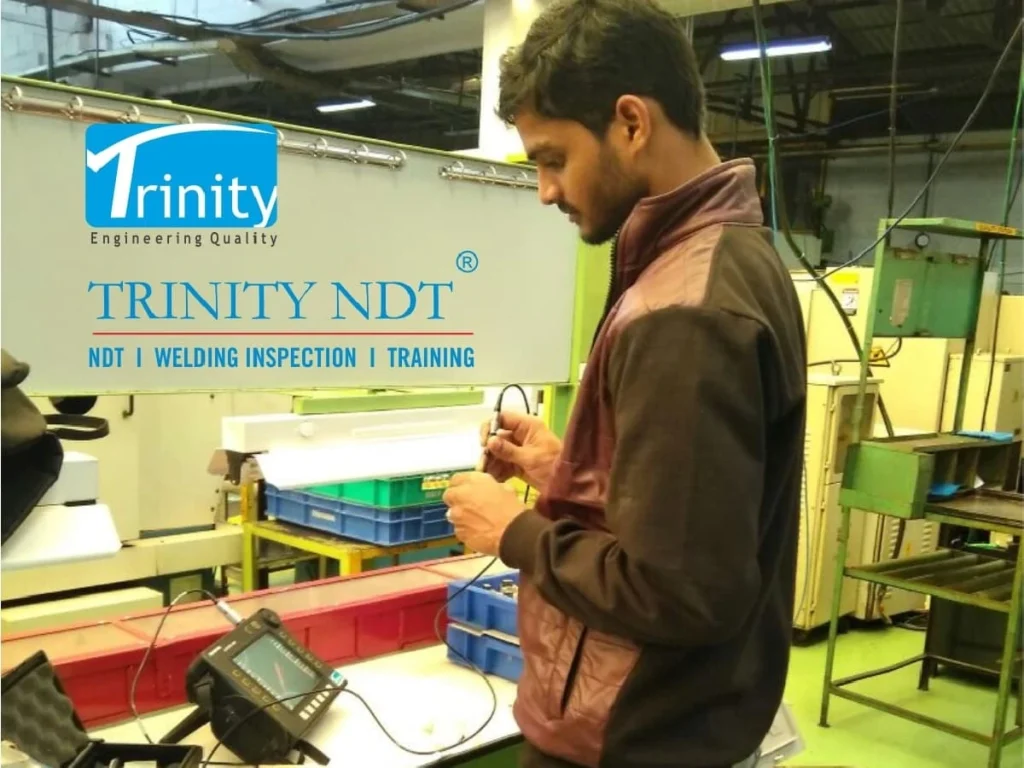
Of all six conventional NDT methods, Eddy Current Testing training for Level II commands the highest salary premium in India and internationally — because it requires both theoretical depth and significant practical skill to be effective. A capable ET Level II with heat exchanger tube inspection experience is actively sought across the Middle East, South-East Asia, and Africa.
Job Roles
- ET Level II Inspector / Heat Exchanger Inspector — Refinery turnaround contracts (India, Gulf, Africa)
- NDT Technician — ET / Tube Testing — Third-party inspection companies (Bureau Veritas, TÜV, Intertek, SGS)
- Aerospace NDT Inspector (ET) — HAL, ISRO, DRDO, licensed MRO centres
- QC Engineer — Eddy Current — Heat exchanger OEMs (ISGEC, Thermax, HEC, L&T)
- Tube Testing Analyst — Data interpretation for heat exchanger condition assessment reports
- NDT Level II Inspector (All Methods) — Multinational TPI agencies overseas (Middle East, Africa)
- Advanced ET Technician — PAUT/ECA systems operator in aerospace or power sector
Salary & Market - India & World
- Fresher ET Level II — ₹3.5–5 LPA (India)
- Experienced ET Inspector (3–5 years) — ₹6–12 LPA (India)
- Heat Exchanger ET Inspector — Gulf (Saudi, UAE, Kuwait) — USD 3,000–6,000/month
- Offshore/Turnaround Contract ET Inspector — USD 400–700/day per diem rates
- Market demand: Every petroleum refinery in India conducts at least one major turnaround inspection per year — each requiring 5–15 certified ET tube inspectors
- Placement: Trinity NDT offers free placement assistance to all certified ET graduates
Choose Your Learning Mode — Online or Offline
Offline — In-Person at Bangalore
- 5-day classroom sessions at Aspire Auditorium, 4th Phase Peenya
- Full hands-on practicals with professional EC instruments
- Heat exchanger tube inspection practical — actual tube mock-up specimens
- Surface crack detection on real test specimens
- Material sorting / conductivity measurement exercise
- Impedance plane interpretation on live instrument display
- Full examination (general + specific + practical) on Day 5
Certificate issued within one week
Best for: Engineers wanting genuine instrument-level proficiency and hands-on tube inspection confidence.
Online — Live Virtual (Attend from Anywhere in the World)
- Live instructor-led sessions via Zoom / Teams — not recorded playback
- Full theory curriculum: electromagnetic principles, impedance plane, all techniques
Digital study materials, code extracts, and reference charts sent in advance - Interactive impedance plane analysis exercises using screen-shared simulations
- Written examination (general + specific) conducted online under supervision
- Certificate issued after successful examination
- Practical add-on session at Bangalore available separately
Best for: Working professionals at refineries or power plants, engineers overseas, and candidates seeking the SNT-TC-1A theory certification first.
📌 On-site ET training at your facility is available anywhere in India for companies with 6+ candidates. We bring instruments and tube specimens to your location. Conducted extensively at refineries in Mumbai, Chennai, Vizag, Kochi, Hyderabad, and Delhi. Contact info@trinityndt.com | +919844129439
What ET Course Level I/II Certified Candidates Say
| Dates | Course | Scheme | Mode | Seats | Action |
|---|---|---|---|---|---|
| Contact for Dates | ET Level I & II | ASNT SNT-TC-1A | Offline — Bangalore | Open | Enquire |
| Monthly | ET Level II | ASNT SNT-TC-1A | Online — Live | Open | Enquire |
| Contact for Dates | ISO 9712 ET Level II | ISO 9712 | Offline — Bangalore | Limited | Enquire |
📅 Full 2026 calendar: View Complete Training Schedule →
I worked in a refinery maintenance department and we always outsourced heat exchanger tube inspection. After Trinity NDT's Eddy current testing training Level II course, I could now do the tube testing in-house and interpret the impedance plane signals myself. The heat exchanger mock-up practical was exactly what we deal with on site — wall thinning signals, support plate suppression, pitting. World-class training.
Mr Smit H Shah
Maintenance Engineer, Petroleum Refinery, Gujarat ★★★★★
I attended the online ET Level II from Dubai. The theory sessions on impedance plane analysis and frequency selection were among the best NDT lessons I have ever received — Ravi sir explained the skin depth formula with real practical examples from aerospace and tube inspection. Even the online batch covered all the theory I needed to pass my company's ET Level II examination.
Mr Hussain
— NDT Inspector, Offshore Inspection Services LLC, Dubai ★★★★★
Our company needed to certify 8 engineers in ET Level II for a new heat exchanger inspection contract. Trinity NDT sent their ASNT Level III trainer to our Chennai facility — he brought the EC instrument and tube specimens. All 8 engineers passed. The trainer's knowledge of ASME Section V Article 8 and real-world tube defect interpretation was outstanding.
Mr Kumaravel S
QC Manager, Heat Exchanger Manufacturer, Chennai ★★★★★
Frequently Asked Questions — ET Level I & II Certification Course
Unlike Visual Testing (observe the surface), Penetrant Testing (apply, remove, observe), or even Magnetic Particle Testing (apply field, observe indications), Eddy Current Testing requires the technician to interpret abstract impedance plane signals — not visible indications on the test material. The shape, phase angle, amplitude, and trajectory of a signal on an impedance plane display must be correctly interpreted to distinguish a crack from liftoff, a pit from a support plate, or alloy variation from wall thinning. This requires deep theoretical understanding and significant hands-on practice. Trinity NDT’s ET course spends more time on impedance plane interpretation than any other subject — because this is where ET competence is actually built or lost.
Conventional Eddy Current Testing works well on non-ferromagnetic materials (copper alloys, stainless steel, titanium, aluminium) but cannot inspect through the full wall of ferromagnetic materials like carbon steel or low-alloy steel tubes because the high magnetic permeability confines the eddy currents to a very thin surface layer. Remote Field ET (RFET) uses a different physical principle — an exciter coil and receiver coil spaced approximately two tube diameters apart — that allows full-wall penetration of ferromagnetic tubes. RFET is used for carbon steel boiler tubes and cast iron water mains that conventional ET cannot inspect effectively.
The Level II certification course (40–80 hours classroom + practical) teaches you the principles and gives initial hands-on tube inspection experience. However, proficiency in tube inspection data interpretation typically develops over 3–6 months of on-the-job experience with actual heat exchanger data — dealing with real-world signals from corroded, pitted, and worn tubes in production environments. Trinity NDT’s course is specifically designed to give you the theoretical depth and practical foundation that makes this learning curve as short as possible. We use actual refinery-grade tube specimens with real defect profiles — not artificial classroom specimens.
Can I attend the Eddy current testing training course online, and will I get the same certification?
The ASNT SNT-TC-1A ET Level II theory component is fully available in our live virtual online format via Zoom. The written general and specific examinations are also conducted online under supervision. The resulting certification is the same as for offline participants. However, the practical component — actual operation of an EC instrument, tube probe insertion, and signal interpretation on a live display — is only possible in the offline Bangalore course. For online graduates who need to demonstrate practical competence to their employer, a separate practical add-on session at our Bangalore laboratory can be arranged.
As per ASNT SNT-TC-1A (2024 edition) Table 6.3, the minimum on-the-job training hours for ET Level II (direct entry) are 630 hours. If the candidate completes Level I first (200 OJT hours), and then upgrades to Level II, an additional 430 hours of OJT is required. OJT hours are accumulated at the workplace under supervision and must be documented and signed by the employer’s Level III before the final certification examination. Attending Trinity NDT’s training course counts toward the classroom training requirement — the OJT hours are accumulated separately at your workplace.
The highest demand for ET Level II in India is in petroleum refinery heat exchanger inspection — every IOCL, HPCL, BPCL, Reliance, and ONGC refinery conducts annual or biennial turnaround inspections requiring ET teams. Power generation companies (NTPC, BHEL, Tata Power) need ET for boiler and condenser tube inspection. Aerospace companies (HAL, ISRO, DRDO) require NAS 410 ET Level II for surface crack detection. Salaries: ₹3.5–5 LPA for freshers in India, rising to ₹8–15 LPA with 5 years of heat exchanger and aerospace experience. Gulf market: USD 3,000–6,000/month for experienced ET tube inspectors on refinery turnaround contracts.
Master Eddy Current Testing Training today. You can Enrol in India's Most Complete ET Level II Course.
Heat Exchanger Tube Practicals · Impedance Plane Mastery · Aerospace Surface Scanning · NABL Lab
Online batches run monthly. Offline batch seats are strictly limited to 10.
Training coordinator responds within 2 hours.
📞 +91 98441 29439 | 📧 training@trinityndt.com | Peenya, Bangalore