By Ravi Kumar Thammana | ASNT Level III — UT, RT, MT, PT, VT, ET | IWE | NAS 410/ISO9712 Level III | CEO, Trinity NDT WeldSolutions Pvt. Ltd., Bangalore, India
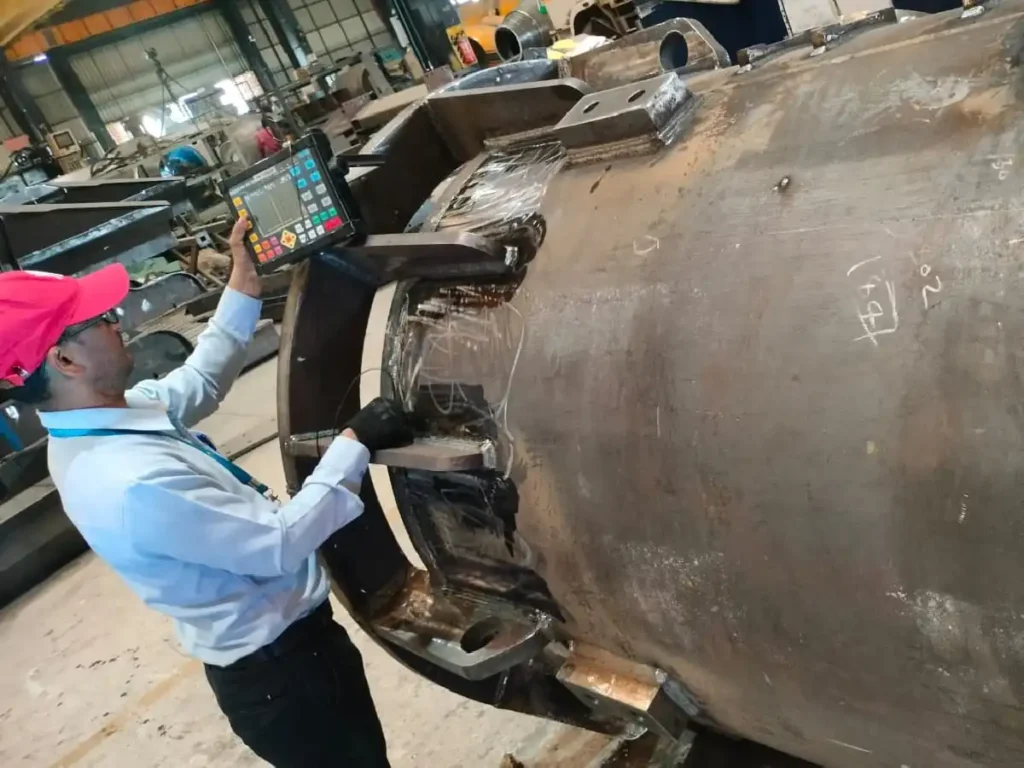
Let me start with something I tell every candidate who attends our UT Level II training in Bangalore.
Knowing how to perform an ultrasonic test — how to set up the instrument, calibrate the DAC curve, scan the weld, and find an indication — is half the job. The other half, equally important and far more frequently misunderstood, is knowing what to do with what you find. How long is too long? How strong an echo is too strong? When do you call a weld rejected — and when do you leave it in service?
Those questions are answered by acceptance standards. And for ultrasonic testing of welds in the ISO world, the primary acceptance standard is ISO 11666:2018 — Non-Destructive Testing of Welds — Ultrasonic Testing — Acceptance Levels.
In nearly three decades of doing and teaching UT in Indian industry, I have found ISO 11666 to be one of the most misquoted, misapplied, and misunderstood standards in the NDT practitioner’s toolkit. Engineers mix it up with ISO 17640 (the testing technique standard). They confuse its acceptance levels with those in ASME Section VIII. They apply AL2 where AL3 was specified — or vice versa — without understanding what the practical consequence is.
This article is my attempt to fix that. We will go through ISO 11666:2018 from beginning to end — the scope, the logic, the numbers, the practical application, and the relationship to every other standard in the ISO weld inspection family. By the end, you will be able to look at a UT test report referencing this standard and know exactly what it means.
What ISO 11666 Is — And What It Is Not
Before we go any further, let us establish clearly what ISO 11666 does and does not cover.
ISO 11666 tells you: Given an ultrasonic indication found during UT of a weld, what amplitude and length criteria determine whether it is acceptable or rejectable?
ISO 11666 does not tell you: How to perform the UT test. Which probes to use. How to calibrate the instrument. What scanning patterns to follow. All of those are covered by ISO 17640 — Non-Destructive Testing of Welds — Ultrasonic Testing — Techniques, Testing Levels and Assessment — which is the technique standard that ISO 11666 depends upon.
Think of it this way: ISO 17640 tells you how to look. ISO 11666 tells you what you are allowed to find. They work together — and you cannot apply one without the other. Every UT of a weld to ISO standards is a two-standard exercise: technique per ISO 17640, acceptance per ISO 11666.
Scope and Application — What This Standard Covers
ISO 11666:2018 was published in 2018 as the second edition, replacing ISO 11666:2010. As of 2025, a new committee draft (ISO/CD 11666) is under development — so a third edition is on the horizon. However, the 2018 edition remains the active international standard and is the version cited in the vast majority of current contracts and codes.
The standard applies to:
Full penetration welded joints in ferritic steels with thicknesses from 8 mm to 100 mm. This is the primary scope — the application that covers the overwhelming majority of welded pressure vessels, structural steel, pipelines, and process piping in Indian and international fabrication.
It can also be used for other types of welds, materials and thicknesses, provided the tests have been performed with necessary consideration of the geometry and acoustic properties of the component, and an adequate sensitivity can be employed to enable the acceptance levels of this document to be applied.
This second paragraph is more important in practice than the first. It is the clause that experienced practitioners use to apply ISO 11666 to austenitic stainless steel welds, aluminium alloy welds, and nickel alloy welds — always with the caveat that the UT technique must be appropriate for the material, and that adequate sensitivity to the relevant indication sizes must be demonstrably achievable.
What the standard does NOT apply to:
- Partial penetration welds — fillet welds, tee joints with partial penetration, overlay welds
- Welds in materials below 8 mm thickness (for thin section, other standards apply)
- Welds in materials above 100 mm thickness (special thick-section procedures are required)
- Austenitic stainless steel welds where specific acoustic problems preclude adequate sensitivity without specific additional provisions
The ISO Weld Inspection Standard Family — Understanding Where ISO 11666 Fits
To understand ISO 11666 properly, you need to understand the ecosystem of ISO standards it belongs to. These standards are not independent — they form a structured hierarchy.
ISO 5817:2014 — Welding — Fusion-welded joints in steel, nickel, titanium and their alloys (beam welding excluded) — Quality Levels for Imperfections
This is the foundational document that defines what imperfection sizes and types are acceptable for different applications of welded joints. ISO 5817 defines three weld quality levels:
- Quality Level B — the highest quality; strictest limits on imperfection sizes
- Quality Level C — intermediate quality; moderate limits
- Quality Level D — the lowest quality; most permissive limits
These three quality levels are the starting point for everything in the ISO weld acceptance world. When a contract specifies “ISO 5817 Quality Level B welds”, it is saying: every weld in this project must meet the strictest permissible imperfection limits.
ISO 17640:2018 — Non-Destructive Testing of Welds — Ultrasonic Testing — Techniques, Testing Levels and Assessment
This is the testing technique standard. It defines how UT of welds shall be performed — probe selection, frequency, scanning technique, calibration, recording level, and how to determine the length of an indication. It defines four testing levels (A, B, C, and D) of increasing thoroughness, corresponding to the criticality of the application.
ISO 11666:2018 — Non-Destructive Testing of Welds — Ultrasonic Testing — Acceptance Levels
This is what we are discussing today. It takes the findings produced by a UT test performed per ISO 17640 and tells you whether those findings are acceptable or rejectable, at one of two acceptance levels that correspond to ISO 5817 quality levels.
The relationship is beautifully systematic: the quality of the weld (ISO 5817) drives the strictness of the testing (ISO 17640 testing level) which drives the strictness of the acceptance criteria (ISO 11666 acceptance level). Everything ties together.
The Two Acceptance Levels — AL2 and AL3
ISO 11666:2018 specifies two ultrasonic acceptance levels known as acceptance level 2 (AL 2) and acceptance level 3 (AL 3) for full penetration welded joints in ferritic steels, which correspond to ISO 5817:2014, quality levels B and C.
Let me be very specific about what these numbers mean and which is stricter — because this is where confusion consistently occurs.
Acceptance Level 2 (AL2) = ISO 5817 Quality Level B = The STRICTER level
Acceptance Level 3 (AL3) = ISO 5817 Quality Level C = The LESS STRICT level
The counterintuitive thing for newcomers is that a lower number (2) is the stricter acceptance level. This follows the ISO 5817 convention where Quality Level B (the best) is stricter than Quality Level C, which is in turn stricter than Quality Level D. The numbering reflects the ISO 5817 quality level letters: B = 2, C = 3.
An acceptance level corresponding to ISO 5817:2014, quality level D is not included in this document, as ultrasonic testing is generally not requested for this weld quality.
This is a logical and practical decision. ISO 5817 Quality Level D represents the most lenient weld quality — welds where relatively large imperfections are acceptable. For such welds, UT is typically not a contractual requirement because the quality level is low enough that the effort and cost of ultrasonic testing is disproportionate to the application’s criticality.
The Three Levels You Must Understand — Recording, Evaluation, and Acceptance
One of the most common sources of confusion in applying ISO 11666 is the distinction between three different amplitude thresholds that appear in the standard. These are not the same thing, and mixing them up leads to incorrect reporting.
The Recording Level (also called the Detection Level)
This is the amplitude threshold above which the technician must write the indication into the test record. Every indication that exceeds the Recording Level must be documented — its location, depth, length, and amplitude relative to the reference level. The recording level does NOT determine acceptance or rejection — it only determines what gets written down.
Per ISO 17640 and ISO 11666, the evaluation levels are expressed in dB relative to the reference DAC (Distance-Amplitude Correction) curve established from a reference reflector (typically a 3 mm side-drilled hole in the calibration block of the same material and nominal thickness as the test object).
Evaluation and Acceptance Levels
The Evaluation Level
This is the amplitude above which the technician must measure the indication’s length (using the 6 dB drop method or the specified echo-amplitude method) and assess it against the acceptance criteria. Indications above the recording level but below the evaluation level are recorded in full but their length does not need to be measured and they are not evaluated against the acceptance criteria tables.
In ISO 11666:2018, the evaluation levels for techniques 1 to 4 are given in ISO 11666:2018, Table A.1. These are expressed as dB values below the reference DAC level — typically in the range of DAC -10 dB or DAC -6 dB depending on the technique and thickness range.
The Acceptance Level
This is the maximum amplitude and maximum length that an indication may have while still being classified as acceptable. An indication that exceeds either the amplitude acceptance criterion OR the length acceptance criterion (or both) at its given evaluation level must be classified as rejectable.
Understanding the hierarchy — Recording → Evaluation → Acceptance — is the key to reading ISO 11666 correctly.
How the Acceptance Criteria Work — The Practical Application
The core of ISO 11666 is a set of tables that relate:
- Wall thickness of the weld joint (which affects the amplitude reference level and the length acceptance criteria)
- Amplitude of the indication (expressed in dB relative to the H0 reference level — the point on the DAC curve at the depth of the indication)
- Measured length of the indication (determined by the 6 dB drop method or echo-amplitude method)
These three variables together determine whether an indication is accepted or rejected.
Let me work through this in practical terms.
Setting Up the Reference — What H0 Means
H0 is the amplitude reference point in ISO 11666 — it is the amplitude of the echo from the reference reflector (a 3 mm diameter flat-bottom hole or side-drilled hole, depending on the technique) at the same metal path distance as the indication being evaluated, as read from the DAC curve.
This is critical: H0 is not a fixed point on the instrument. It changes with depth. When you evaluate an indication at 20 mm depth, H0 is the DAC curve amplitude at 20 mm. When you evaluate an indication at 50 mm depth, H0 is the DAC curve amplitude at 50 mm. The DAC curve automatically accounts for sound attenuation with distance, so H0 always represents the same equivalent flaw size regardless of depth.
What the Acceptance Tables Tell You
For each combination of acceptance level (AL2 or AL3) and weld thickness range, the acceptance table gives you pairs of conditions. An indication must be evaluated against both conditions — amplitude and length — and must satisfy BOTH to be accepted.
In simplified practical terms, for a typical structural steel weld at Acceptance Level 2:
An indication is accepted if BOTH of the following apply:
- Its amplitude does not exceed H0 (the DAC curve amplitude at that depth), and Its measured length does not exceed a specified fraction of the wall thickness (typically t/4 for certain thickness ranges)
An indication is rejected if EITHER:
- Its amplitude exceeds H0 at any depth, OR
- Its length exceeds the maximum permitted regardless of amplitude, OR
- Its amplitude and length combination falls above the acceptance line in the table
The elegance of this system is that it mirrors real-world defect behaviour: large but shallow and short indications may be acceptable, while long continuous linear indications are rejectable even at relatively low amplitudes, because a long linear discontinuity (which could be a crack, a linear slag line, or a lengthy area of lack of fusion) is always more dangerous than an isolated point reflector.
The Amplitude-Length Relationship — The Key Insight
There is a principle embedded in the ISO 11666 tables that every practising UT inspector should internalise:
As an indication’s length increases, the maximum acceptable amplitude decreases.
Or stated another way: the longer the indication, the stricter the amplitude criterion. A short indication (length less than half the wall thickness, for example) may be accepted at full H0 amplitude. But a long indication — one whose length approaches or exceeds the wall thickness — must have an amplitude significantly below H0 to be accepted.
Why? Because length is a proxy for defect type and severity. A point-like porosity pore gives a short indication. A slag inclusion can give a moderate-length indication. But lack of fusion — particularly if it extends over a long run of the weld — gives a long indication. And lack of fusion, being a planar defect with potential stress-concentration effect, is far more dangerous in service than an equivalent-length chain of porosity. The amplitude-length relationship in the acceptance tables reflects this physical reality.
AL2 vs AL3 — When to Apply Which, and Why It Matters
The choice of acceptance level for a given weld is one of the most important decisions in a UT inspection contract. It is not a decision that should be made by the NDT inspector on site — it should be specified in the inspection contract, the design documentation, or the applicable product standard.
Here is the practical guidance:
Apply AL2 (the stricter level) when:
- The weld carries high stress or is in a fatigue-critical location
- The weld is in a pressure-retaining system (pressure vessels, boilers, pipelines) where failure could cause catastrophic release
- The applicable product standard or contract specifies ISO 5817 Quality Level B
- The weld joins safety-critical structural members — primary load-bearing joints in bridges, offshore platforms, or building frames
- Failure of the weld would have significant consequences for life safety or environmental integrity
- The design has been based on weld quality Level B assumptions
Apply AL3 (the less strict level) when:
- The weld is in a lower-criticality structural application
- The applicable product standard or contract specifies ISO 5817 Quality Level C
- The weld carries static (non-cyclic) loading and the design tolerates a larger imperfection
- The fabrication is categorised as standard quality rather than special quality
The critically important point: The contract or product standard determines the acceptance level. The inspector applies it — but does not choose it. If you receive a UT contract with no acceptance level specified, this must be resolved before testing begins. Applying AL3 where AL2 was required, or vice versa, is a significant quality failure — not just an administrative one. It can result in unsafe welds being accepted into service, or acceptable welds being unnecessarily rejected.
The Length Measurement Question — 6 dB Drop vs Echo-Amplitude Method
One area where ISO 11666 gives inspectors a choice — but a choice that must be consistently documented — is in the method for measuring indication length.
The 6 dB Drop Method
The probe is scanned along the weld axis until the echo from the indication drops to half its maximum amplitude (a 6 dB reduction). The distance between the two 6 dB drop positions along the scan axis is reported as the indication length. This method is straightforward, well-understood, and appropriate when the indication is reasonably distinct and not near the weld root or cap.
The Echo-Amplitude Method (DAC-based)
The inspector scans the probe along the weld until the indication amplitude falls below a specified threshold relative to H0, then reports the distance between those threshold-crossing positions as the indication length. This method tends to give shorter reported lengths than the 6 dB drop method for the same indication — which means that choosing this method rather than 6 dB drop for the same indication may be the difference between acceptance and rejection.
This is not a trick — it is a legitimate technical approach, and ISO 11666 permits both methods. But the method must be specified in the written procedure and consistently applied. An inspector who switches between methods depending on which gives a more convenient result for a marginal indication is not practising good NDT — and any competent reviewer of the test records would spot this immediately.
The Relationship with ISO 17640 Testing Levels — A Table Worth Understanding
In addition to possessing general knowledge of ultrasonic weld testing, personnel must also understand the testing challenges specifically associated with the type of welded joints under examination.
ISO 17640 defines four testing levels — A, B, C, and D — of increasing thoroughness and coverage. The choice of ISO 17640 testing level determines the scanning coverage, the probe angles used, and the number of probe positions. ISO 11666 acceptance levels are linked to ISO 17640 testing levels:
| ISO 17640 Testing Level | ISO 11666 Acceptance Level | Typical Application |
|---|---|---|
| A | Not defined for AL2/AL3 | Limited scope — basic detection only |
| B | AL2 or AL3 | General fabrication — standard weld inspection |
| C | AL2 | Critical applications — higher scanning coverage |
| D | AL2 | Very critical applications — special techniques |
The important implication is that a contract specifying AL2 will almost certainly require ISO 17640 Testing Level B or C, because only the more comprehensive scanning coverage provided by those testing levels can reliably detect the smaller indications that AL2 is intended to control.
Conversely, a contract that specifies ISO 17640 Testing Level B but AL3 is a contract for moderately thorough scanning with moderately lenient acceptance — appropriate for secondary structural members in non-critical applications.
Transfer Correction — The Most Frequently Missed Step
Transfer differences, between test object and reference block, at a representative number of locations. ISO 16811 describes suitable techniques for this evaluation. When the differences are less than or equal to 2 dB, inspectors do not need to apply correction. The differences exceed 2 dB but remain less than or equal to 12 dB, inspectors must compensate for them. Transfer losses exceed 12 dB, inspectors must investigate the cause and carry out further preparation of the scanning surface.
This is one of the most practically significant provisions in the standard — and one of the most consistently overlooked in routine inspection work.
The calibration block has a smooth, flat surface. The inspected weld may have a rough surface due to the as-welded condition, scale, or minor corrosion. This surface roughness introduces additional sound attenuation, reducing the sound entering the weld compared with the amount that entered the calibration block. If inspectors do not measure and compensate for this transfer difference, the actual sensitivity becomes lower than assumed, causing the system to miss small indications that should have appeared above the recording level.
The correct procedure: after calibrating on the reference block, measure the DAC amplitude using the same probe on the actual weld surface at several representative locations. The difference between this reading and the calibration block reading is the transfer correction. If the difference exceeds 2 dB, inspectors must increase the instrument gain by the correction value before the test begins.
In my experience training UT Level II candidates, transfer correction is the step that separates the technician who follows a procedure from the technician who understands what the procedure is trying to achieve.
What the 2018 Revision Changed From the 2010 Edition
For those who have worked with ISO 11666:2010 and are updating their knowledge, the 2018 revision introduced several important clarifications and updates:
Clearer correlation with ISO 5817:2014: The 2018 edition more explicitly links AL2 to ISO 5817 Quality Level B and AL3 to ISO 5817 Quality Level C, making it easier to use the standard in conjunction with quality requirements specified per ISO 5817.
The revised Table A.1 aligns the evaluation level table with the updated ISO 17640:2018 technique definitions, particularly for the four standard techniques.
Expanded guidance on non-ferritic materials: The 2018 edition provides slightly more guidance on applying the acceptance criteria to non-ferritic materials where specific acoustic properties affect the validity of the reference calibration.
The 2018 edition clarifies that inspectors must establish the recording threshold before scanning begins and cannot retrospectively adjust it to change the documented results.
As of late 2024, the committee registered a new draft standard (ISO/CD 11666) to replace ISO 11666:2018 and initiated committee drafting in December 2025. The comment period closed in February 2026. This indicates that the committee is likely to publish a new edition within the next two to three years. NDT professionals working to this standard should monitor ISO’s publications for the DIS (Draft International Standard) — which will give advance notice of any significant changes to the acceptance criteria.
Applying ISO 11666 with PAUT — A Growing Practical Question
One of the questions that advanced UT practitioners ask me most frequently is whether they can apply ISO 11666 acceptance criteria to Phased Array Ultrasonic Testing (PAUT) results.
The short answer is: yes, with important conditions.
There is a document that specifies the application of the phased array technology for the semi- or fully automated ultrasonic testing of fusion-welded joints in metallic materials of minimum thickness 6 mm. It applies to full penetration welded joints of simple geometry in plates, pipes, and vessels, where both the weld and the parent material are low-alloy and/or fine grained steel.
The relevant companion standard for PAUT of welds is ISO 13588 — which covers the PAUT technique for weld inspection and references ISO 11666 acceptance levels. When inspectors use PAUT to perform weld UT in accordance with ISO 17640 technique requirements and express the results in equivalent amplitude terms relative to the same reference reflector (3 mm SDH or FBH), they can apply the ISO 11666 acceptance tables directly.
The critical condition requires the PAUT technique to demonstrate, through validation, that it achieves at least equivalent detection capability to the manual UT technique it replaces. The amplitude reference calibration must use the same reference reflector as specified for the manual technique. When PAUT produces results in S-scan or E-scan format, inspectors must properly extract the maximum amplitude at any point in the weld cross-section and compare it with the acceptance criteria.
PAUT done properly to ISO standards is a powerful tool — faster, more reproducible, and often more sensitive than manual UT for complex weld geometries. PAUT done without proper calibration and without attention to the acceptance standard requirements is just impressive-looking data that may not mean what the client thinks it means.
A Worked Example — From DAC Calibration to Accept/Reject Decision
Let me take you through a realistic scenario — the kind of situation that comes up on the shop floor regularly.
The Setup:
- Butt weld in carbon steel pressure vessel
- Wall thickness: 30 mm
- Acceptance level specified: AL2 (ISO 5817 Quality Level B)
- Testing per ISO 17640, Testing Level B
- Technique: Angle beam, 60° probe, 4 MHz, single angle
- Calibration: DAC curve from 3 mm SDH in reference block, 30 mm thickness, same material
The Calibration: You establish the DAC curve. At the 30 mm metal path depth, your DAC amplitude corresponds to the response from the 3 mm SDH. You set this as H0 at that depth. You adjust sensitivity to bring this point to 80% full screen height (FSH) — a standard reference point.
The Scan: You scan the weld. You find an indication at approximately 22 mm depth (metal path). The maximum echo amplitude from this indication is 72% FSH. You note that it exceeds the recording level, which you set below DAC—perhaps at DAC -10 dB, equivalent to about 25% FSH. You stop and evaluate.
Reading H0 at 22 mm depth: From your DAC curve, at 22 mm metal path, the DAC is — let’s say — 78% FSH. So your indication amplitude of 72% FSH is below H0. In dB terms, it is approximately 0.7 dB below H0. This means the indication is below the maximum amplitude acceptance criterion of H0.
Length Measurement: You measure the indication length using the 6 dB drop method. The amplitude drops from 72% FSH to 36% FSH (half) at two positions along the weld axis. The distance between these positions: 18 mm.
Applying the Acceptance Table
For AL2 with a 30 mm wall thickness and an indication amplitude below H0, what maximum length does the standard permit?
The ISO 11666:2018 Table gives maximum indication lengths that depend on the amplitude relative to H0 and the wall thickness. For an indication at or below H0 in a 30 mm wall, the standard typically expresses the maximum permitted length as a fraction of the wall thickness.Approximately t/2 for the amplitude level under discussion—which corresponds to 15 mm.
Our indication is 18 mm long. The acceptance criterion is 15 mm. AL2 rejects this indication.
Evaluators would need to reassess the same indication against the AL3 acceptance criteria to determine whether the less stringent level would accept it. Although that assessment remains academic from a contractual standpoint if the contract specifies AL2. It belongs in a fitness-for-service assessment, not the inspection report.
The Most Common Mistakes I See in ISO 11666 Application
After reviewing test reports and conducting audits for fabricators and inspection companies across India, these are the recurring errors:
Mistake 1 — Applying AL3 instead of AL2 because it is “easier to pass” The acceptance level is specified in the contract. Applying the wrong level — intentionally or through carelessness — is a quality system failure. Any reputable inspection company that discovers this has happened must issue a corrected report and notify the client.
Mistake 2 — Not performing transfer correction The calibration block surface is different from the weld surface. If the difference is more than 2 dB, correction is mandatory. Many inspectors on site skip this step because it adds time. It compromises the sensitivity of the inspection.
Mistake 3 — Measuring length by eye rather than by the 6 dB drop method “It looks about 15 mm long” is not a length measurement. Inspectors must use and document the 6 dB drop method or the echo-amplitude method.
other Common Mistakes That Needs Consideration
Mistake 4 — Confusing the evaluation level with the acceptance level. Inspectors must assess an indication that exceeds the evaluation level; they cannot automatically reject it. Many technicians incorrectly treat exceeding the evaluation level as a rejection. It is a threshold that triggers length measurement and acceptance assessment.
Mistake 5 — Using calibration blocks of the wrong material ISO 17640 and ISO 11666 require that the calibration block be of the same material group. As the test object.
Using a carbon steel calibration block for a 316L stainless steel weld inspection will give incorrect sensitivity because the acoustic properties differ.
Mistake 6 — Failing to specify the acceptance level in the test report. Every UT weld test report should clearly state the applied acceptance level (AL2 or AL3). The evaluation level in dB, the recording level in dB, and the reference reflector used. Reports that omit this information are incomplete and non-compliant with ISO 17640 reporting requirements.
How ISO 11666 Relates to Other Major UT Acceptance Standards
For practitioners who work across multiple code environments, here is the orientation table that I share in our UT Level II training:
| Standard | Region | Application | Acceptance Basis |
|---|---|---|---|
| ISO 11666:2018 | International (ISO framework) | General ferritic steel welds, 8–100 mm | DAC amplitude + length per AL2 or AL3 |
| ASME Section V Art. 4 / Section VIII | USA origin, global use | Pressure vessels and boilers | DAC amplitude — typically 100% DAC reject for ASME VIII |
| AWS D1.1 | USA origin | Structural steel welding | Amplitude + length per Class B or Class C tables |
| API 1104 | USA origin | Pipeline welding | Amplitude + length per specific API criteria |
| EN 1712 (superseded by ISO 11666) | European | Welds — now replaced by ISO 11666 | AL1/AL2 per EN system — now mapped to ISO 11666 |
| DNV-OS / GL rules | Marine / offshore | Marine structures and vessels | References ISO 11666 or own acceptance tables |
The important thing to note: ASME and ISO acceptance systems are fundamentally different in their approach. ASME uses a simpler reject/accept binary based primarily on whether the indication exceeds the DAC curve. A DAC-crossing indication is typically rejectable (with some additional evaluation criteria). ISO 11666 uses a more nuanced system in which amplitude and length together determine acceptance. Thus allowing inspectors to accept certain above-DAC indications if their length remains within permissible limits.
This means you cannot substitute one for the other without understanding which is more conservative for a given indication. ASME might reject a short but high-amplitude indication that ISO 11666 AL3 would accept.While certain ASME interpretations might accept a long but moderate-amplitude indication that ISO 11666 AL2 would reject. Know your code, and apply it correctly.
Writing the ISO 11666 UT Test Report
The ISO 17640 reporting requirements (which govern the test report for UT of welds using ISO 11666 acceptance criteria) specify that every compliant test report must include:
- Name of the testing organisation and name of the inspector
- Inspector’s qualification level and certification scheme
- Name of the client and identification of the tested object
- Material specification, dimensions, and condition of the weld
- Testing standard: ISO 17640, testing level specified
- Acceptance standard: ISO 11666:2018, acceptance level applied (AL2 or AL3)
- Reference reflector: type (SDH or FBH), diameter, location in calibration block
- Probe details: type, frequency, angle, size, manufacturer, serial number
- Instrument type and serial number
- Calibration date and reference (instrument must be in calibration)
- Recording level, evaluation level, and acceptance level in dB relative to H0
- Transfer correction applied (value in dB, or statement that correction was less than 2 dB)
- Scanning pattern and coverage achieved
- For each recorded indication: location, depth, measured length, maximum amplitude (relative to H0), assessment (Accepted/Rejected)
- Overall conclusion: Accepted or Rejected
- Date of testing
- Authorised signature — minimum UT Level II per applicable certification scheme
A report that is missing any of these elements is incomplete by the standard’s requirements. For NABL-accredited reports (as issued by Trinity NDT WeldSolutions), additional requirements per ISO/IEC 17025 — including measurement uncertainty statement, NABL logo and accreditation number, unique report reference, and non-modification statement — also apply.
The Bigger Picture — Why Acceptance Standards Matter More Than Many Realise
Let me close with something that goes beyond the technical detail.
I started in NDT in the late 1990s, and early on, a conversation with a senior inspector who had worked on refinery piping for two decades struck me deeply. He said something that stayed with me: “The acceptance criterion is not just a number. It is a statement about what humanity has collectively agreed is safe enough.”
That sounds philosophical for an NDT standard. But think about what is behind ISO 11666:2018. The acceptance levels are not guesses or conservative rule-of-thumb estimates. They are the product of decades of fracture mechanics research — understanding how cracks and other weld discontinuities behave under load, how they grow under cyclic stress, at what size they become critical under the design loading conditions of real structures. Research grounds the ISO 5817 quality levels, which in turn drive the ISO 11666 acceptance levels.
When you apply AL2 and reject a weld with an indication that slightly exceeds the acceptance criteria, you are making a decision that the research says that particular combination of amplitude and length represents a risk that the design did not account for and cannot reliably tolerate. When you accept a weld with a 14 mm indication where the limit is 15 mm, you are making a decision that the research says this particular size, in this material, at this depth, is below the threshold at which fracture mechanics predicts failure at the design stress.
This is why the acceptance criterion matters. It is not negotiable based on convenience or client pressure. Every UT inspector who applies ISO 11666 should understand — not just memorise — the principles behind the numbers.
Our UT Testing and Training Services at Trinity NDT
At Trinity NDT WeldSolutions, we provide NABL ISO/IEC 17025:2017 accredited Ultrasonic Testing services for welds in pressure vessels. Also, piping, structural steel, and aerospace components — to ISO 17640 and ISO 11666, as well as ASME Section V, AWS D1.1, API 1104, and other applicable codes. Trinity NDT issues all UT test reports with NABL accreditation. Wherever they fall within scope, giving your quality system independently verified confidence in the results.
Trinity NDT also conducts UT Level I and Level II certification training—both online (live virtual via Zoom) and offline (in-person at its Peenya, Bangalore facility)—covering ISO 11666, ISO 17640, and ASME Section V acceptance criteria in detail using real production radiographs and UT test records.
If you have a specific question about ISO 11666 application — which acceptance level is appropriate for your application. How to handle a borderline indication, or how to write a compliant UT procedure referencing this standard. I am happy to discuss it. That is exactly the kind of technical consultation that we provide as part of our ASNT Level III NDT consulting service.
WhatsApp: +91 98441 29439 | Email: info@trinityndt.com
About the Author: Ravi Kumar Thammana is the CEO and Co-Founder of Trinity NDT WeldSolutions Pvt. Ltd., Bangalore. He holds ASNT Level III certification in all six NDT methods (UT, RT, MT, PT, VT, ET), International Welding Engineer (IWE) from IIW India, NAS 410 Level III (Aerospace NDT), and Radiological Safety Officer (RSO) from AERB/BARC. Trinity NDT holds NABL ISO/IEC 17025:2017 accreditation (TC-5934) and NADCAP Aerospace Merit accreditation. He blogs at materials-testing.blogspot.com.