

Ultrasonic Thickness Gauging (UTG) Level I & II Certification Course
Pipe Wall Thickness · Corrosion Monitoring · Boiler Tubes · Chimneys · Pressure Vessels ASNT SNT-TC-1A · Online & Offline · Bangalore, India — NABL Accredited Lab
- 🏆NABL ISO17025 Accredited UTG Lab
- 🏭Olympus Instruments Practicals
- 🌡️High-Temp Probe Training
- 🌍45+ Countries Engineers Trained Since 2001


Years of UTG Experience
30
+
Clients
1500
+
Measurement Accuacy
0.001
mm
Countries
45
+
Digital Ultrasonic Thickness Testing Level II Certification Course. Online, Offline training schedules in India.
Ultrasonic Thickness Gauging (UTG) is the single most widely used measurement technique in industrial maintenance inspection. And one of the most in-demand skills for QC and maintenance engineers in oil and gas, power generation, petrochemical, and infrastructure sectors.
In fact, the reason is simple: every pipe, vessel, boiler tube, chimney, and storage tank in service is losing wall thickness every year due to corrosion, erosion, and process degradation. As a result, the only reliable, non-destructive way to measure exactly how much wall thickness remains. Without cutting, drilling, or taking the equipment out of service — is Ultrasonic Thickness Gauging.
Furthermore, a trained UTG Level II technician can measure wall thickness on pipes, tubes, vessels, castings, plates, and even painted or coated surfaces with accuracy to ±0.001mm — from the outside, with single-sided access, in minutes. This makes UTG the backbone of every planned maintenance and fitness-for-service inspection programme in Indian industry.
Trinity NDT WeldSolutions Pvt. Ltd at Bangalore, offers UTG Level I and Level II certification training at its NABL ISO/IEC 17025:2017 accredited laboratory in Peenya, Bangalore. Trainees practice on actual industrial specimens, corroded pipe sections, tube samples, plate materials, and chimney flue lining materials. Using Olympus professional digital thickness gauges including the 38DL Plus, other similar series instruments.
In addition, all UTG courses are delivered under the supervision of ASNT/ISO9712 Level III certified instructors. With over 30+ years of active corrosion monitoring and in-service NDT inspection experience across Indian refineries, power plants, process industries, and high-altitude structures.
Moreover, Ultrasonic thickness gauging training is available in online (live virtual) and offline (in-person at Bangalore) formats. On request basis, onsite at-your-facility delivery available anywhere in India.
Comparision of Ultrasonic testing UT Level II & Ultrasonic Thickness Testing Level II Course
🔊 UTG Level II vs Full UT Level II — Which One Do You Need?
| Factor | UTG Level II (Limited) | Full UT Level II |
|---|---|---|
| Purpose | Wall thickness measurement only | Flaw detection + thickness measurement |
| Duration | 2 Days (16 Hours) | 5–6 Days (40–80 Hours) |
| Equipment Used | Digital UTG gauge (Olympus 38DL, 39DL) | Full A-scan flaw detector (Olympus Epoch 650) |
| Best For | Maintenance engineers, corrosion technicians, plant operators | NDT inspectors, QC engineers, third-party inspection |
| Industries | Refineries, power plants, piping, maintenance depts | Fabrication, aerospace, oil & gas, structural inspection |
| Cost | More affordable | Higher investment |
📌 Advice: If your job requires only measuring wall thickness for corrosion monitoring or maintenance inspection then, UTG Level II is the right course. On the other hand, if you need to detect internal flaws (cracks, voids, delaminations) in welds, castings, or forgings — you need Full UT Level II. In many cases, engineers do both. Contact us: +91 98441 29439
UTG Course Details at a Glance
| Parameter | UTG (SNT-TC-1A) Offline |
UTG (SNT-TC-1A) Online |
|---|---|---|
| Duration | 2 Days (16 Hours) | 2 Days (Live Online) |
| Levels Available | Level I (Limited) & Level II | Level II |
| Training Hours | 16 Hours (combined Level I+II) | 16 Hours (theory) |
| Batch Size | Max 12 participants | Max 15 participants |
| Instruments Used | Olympus 38DL Plus, 39DL Plus, TG-110, High-Temp Probes | Theory only (practical at Bangalore add-on) |
| Specimens Used | Corroded pipes, boiler tubes, chimney lining, castings, plates | N/A for theory-only |
| Certificate Issued By | Employer / Trinity NDT | Employer / Trinity NDT |
| Standard | ASNT SNT-TC-1A (Limited Certification) | ASNT SNT-TC-1A |
| Onsite at Your Location | ✅ Pan-India | N/A |
📌 UTG Level II is classified as a “Limited Certification” under ASNT SNT-TC-1A — meaning it covers the specific scope of ultrasonic thickness gauging only. Consequently, it is not a substitute for Full UT Level II which covers flaw detection. Regarding OJT hours, Level I requires 100 hours minimum; Level II requires 400 hours (direct entry) per SNT-TC-1A Table 6.3 for UT Limited scope.
Eligibility Requirements — Who Can Enrol?
| Criterion | UTG Level I (Limited — SNT-TC-1A) |
UTG Level II (Limited — SNT-TC-1A) |
|---|---|---|
| Minimum Education | 10th Standard (High School) | 10th Standard / Diploma / Engineering Graduate |
| Work Experience (OJT) | 100 hours minimum (UT Limited scope) | 400 hours (direct) or 100 hrs (if Level I certified first) |
| Classroom Training | 8 hours minimum | 16 hours minimum (combined Level I+II) |
| Vision Requirement | Near vision (Jaeger J1) + Colour vision | Near vision + Colour vision |
| Prerequisite | None — ideal first NDT course | None (combined Level I+II batch available) |
| Ideal For | Freshers, field operators, maintenance workers | Maintenance engineers, corrosion technicians, plant inspection staff, QC engineers |
Note: 📌 Note on “Limited Certification”: Per ASNT SNT-TC-1A, UTG Level II is issued as a “limited” certification — meaning it authorises the holder to perform ultrasonic thickness gauging only, not full Ultrasonic flaw detection. Many plant maintenance departments and process industry employers specifically require UTG Level II for their corrosion monitoring programmes.
Contact us at training@trinityndt.com to verify how this certification applies to your employer’s written practice.
Instruments You Will Train With — Professional Olympus UTG Equipment
One of the biggest differentiators of Trinity NDT‘s UTG training is the quality of instruments available for hands-on practice. We do not use generic or low-cost demonstration gauges. All offline trainees work with the same Olympus professional instruments used by our NABL-accredited inspection team for actual production inspection — giving you genuine readiness for professional field work.
Olympus 38DL Plus
Industry-leading dual-element digital thickness gauge. A-scan display with gate functions, 5,000+ reading data logger, direct USB download to PC. Resolution 0.001mm. The gold standard for corrosion monitoring on pipes, vessels, and tanks. You will calibrate and operate this instrument during practical sessions.
ASNT Level III & ISO9712 Level III Trainers
UTG is the most technically challenging NDT method. Having an ASNT/ISO9712 Level III with actual field experience in corrosion tube testing and oil, gas tank, piping equipment makes an enormous difference to learning quality — and to exam success.
High-Temperature Probes (DHC Series)
Specialised delay-line probes for thickness measurement at elevated temperatures (up to 300°C and higher with appropriate couplant). Used for inspection of in-service boiler pipes, steam headers, and furnace tubes at operating temperature — without shutting down the plant.
Dual-Element Probes (D790 / D7906)
Pitch-catch transducers that deliver accurate readings on severely corroded, pitted, or rough surfaces where single-element probes give false high readings. Essential for refinery piping and storage tank inspection.
Pencil Probes (Small-Diameter Tubes)
Miniature probes for accessing small-diameter boiler tubes, heat exchanger tubes, and other confined-geometry applications where standard probes cannot fit.
Olympus NDT Software (GageView Pro)
PC-based data download, reporting, and thickness survey visualisation software. You will practice downloading UTG readings from the instrument to PC and generating a grid-format thickness survey report.
Where UTG Level II Certified Inspectors Work — Key Applications
Petrochemical & Refinery Piping (API 570)
The highest-demand UTG application in India. Every IOCL, BPCL, HPCL, and Reliance refinery conducts periodic piping thickness surveys per API 570. Each corrosion loop requires grid-point UTG measurements at defined inspection intervals. This is the most common employer requirement for UTG Level II in India.
Boiler Tubes & Steam Piping (IBR / ASME I)
ASME Section I and IBR (Indian Boiler Regulations) mandate minimum wall thickness compliance for all pressure-containing boiler parts. UTG Level II technicians perform scheduled tube surveys on power boilers, waste heat boilers, and fire-tube boilers across India's power and process sector.
Pressure Vessels (API 510 / ASME VIII)
Shell and head wall thickness measurement during API 510 internal and external inspection intervals. Retirement planning based on measured thickness vs minimum structural thickness per ASME UG-16.
Chimneys, Stacks & High-Altitude Structures
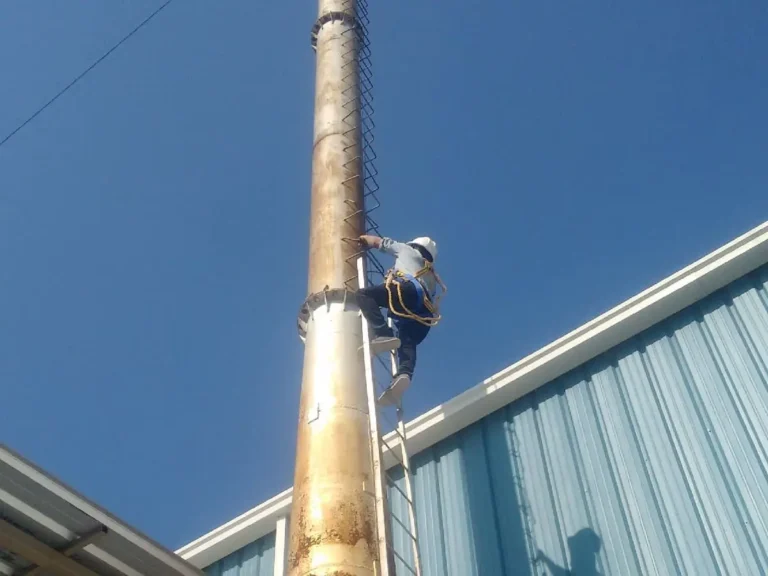
Trinity NDT holds decades of chimney inspection experience — measuring flue lining and steel shell thickness at heights above 100 metres using rope access. Acid condensate corrosion at the dew point zone makes chimney UTG one of the most safety-critical inspection applications.
Above-Ground Storage Tanks (API 653)
Shell plate and floor plate thickness measurement for tank condition assessment. API 653 defines minimum acceptable thickness for continued service of tank shells at various filling levels.
Ship Hulls, Marine & Offshore Structures
Single-sided access from topside or diving access. Measuring remaining hull plating thickness for classification society surveys (Lloyd's, DNV, Bureau Veritas). Widely required for Indian shipyards and offshore platform operators.
Materials You Can Inspect with UTG
UTG works on any material through which ultrasonic waves travel at a constant, measurable velocity and produce a clear back-wall echo. This includes the vast majority of engineering materials used in process plant, power generation, and structural applications:
Metallic Materials:
- Carbon Steel and Low-Alloy Steel (most common)
- Stainless Steel — all grades (304, 316, 321, 347, duplex)
- Aluminium and Aluminium Alloys
- Copper and Copper Alloys (Cu-Ni, Admiralty, brass, bronze)
- Titanium and Titanium Alloys
- Cast Iron (with appropriate frequency selection)
- Nickel Alloys (Inconel, Monel, Hastelloy)
- Chrome-Moly Steel (P11, P22, P91 — power plant piping)
- Duplex and Super Duplex Stainless Steel
- Clad / Weld Overlay (base metal measurement)
Non-Metallic Materials:
- Glass (borosilicate, float glass, sight glasses)
- Plastics (HDPE, PVC, PP, PTFE — with appropriate probes)
- Fibre Reinforced Plastics (FRP) / GRP vessels and pipes
- Rubber Lining (measuring total thickness including lining)
- Epoxy and Ceramic Linings
- Composites (CFRP, GFRP — aerospace and automotive)
- Ceramics (certain types with specific probes)
- Concrete (limited — specialised low-frequency probes)
High temperature UTG Capability
🌡️ High-Temperature UTG — Measure Thickness Without Shutting Down the Plant
One of the most valuable skills in the advanced modules of Trinity NDT's UTG training is high-temperature ultrasonic thickness measurement — measuring wall thickness on pipes and pressure equipment that are at operating temperature, without shutdown or cool-down.
- Special high-temperature delay-line probes handle up to 300°C surface temperature (and beyond with PEEK delay lines)
- High-temperature couplant (propylene glycol, specialised gels) maintains acoustic coupling on hot surfaces
- Sound velocity correction for temperature — steel velocity decreases ~0.5 m/s per °C — must be compensated for accurate readings
- Allows inspection of in-service boiler headers, steam piping, furnace tubes, and fired heater coils without plant shutdown — saving lakhs in lost production
- Trinity NDT has conducted high-temperature UTG at operating temperatures on IBR boilers, fired heater tubes, and process furnaces across India
📌 High-temperature UTG practice is included as a demonstration module in the offline batch. For operators of boilers and fired heaters — this module alone justifies the course.
Why Maintenance Engineers and QC Professionals Choose Trinity NDT for UTG Training
Olympus Make Professional Instruments
Every offline trainee operates the same Olympus 38DL Plus and 39DL Plus instruments used by our NABL-accredited inspection team for actual production contracts. You learn on professional equipment — not on inexpensive demonstration kits.
Full Data Management Training
Most UTG courses stop at measurement. We train you to download data to PC using Olympus GageView software, generate corrosion survey grid reports, calculate corrosion rate and remaining life per API 570, and produce inspection report documentation that satisfies API, ASME, and IBR requirements.
Real Corroded Industrial Specimens
UTG training needs real corrosion — not textbook diagrams. Our specimen collection includes actual corroded refinery pipe sections, pitted boiler tubes, tank plate coupons with varying degradation levels, and chimney liner samples.
NABL Accredited Lab — 30+ Years Experience
All UTG practicals are conducted in our NABL ISO/IEC 17025:2017 accredited laboratory. When you perform UTG at our lab, you do it in the same environment where we produce NABL-certified inspection reports for 1,500+ corporate clients.
High-Temperature Probe Training
We are one of the very few training institutes in India that includes a high-temperature probe demonstration in the UTG course — because in-service hot inspections are a real requirement in refineries, power plants, and process industries.
Chimney & High-Structure Inspection Training
Trinity NDT has two decades of chimney inspection experience at heights above 100 metres. Our UTG course includes specific guidance on chimney inspection methodology, dew point corrosion patterns, and the grid reporting format used for chimney condition assessment — skills not taught anywhere else.
Career Opportunities — UTG Level II Opens Doors Immediately
UTG Level II is one of the most immediately employable NDT certifications in India. Unlike some specialised methods, UTG skills are needed across a very wide range of industries — virtually any industry that operates pressurised equipment, pipelines, storage tanks, or high-temperature processes needs certified UTG inspectors regularly.
Job Roles
- UTG / Corrosion Monitoring Inspector — Refineries, power plants, process industries
- Maintenance Inspection Technician — Plant engineering departments
- Third-Party Inspector (TPI) — BV, TÜV, SGS, Intertek, DNV, Indian TPI agencies
- Corrosion Engineer’s Assistant — API 570 / API 510 inspection team member
- IBR Inspection Support — Boiler inspection per Indian Boiler Regulations
- NDT Field Technician — Turnkey project inspection companies
- Structural Inspection Technician — Bridges, chimneys, port infrastructure
- Onsite UTG Inspector (Gulf/Middle East) — Refinery/petrochemical maintenance projects
Salary & Market
- Fresher UTG Level II (India) — ₹2.5–4 LPA
- Experienced UTG Inspector (3–5 years) — ₹4–8 LPA
- UTG Inspector — Gulf / Middle East — USD 1,500–3,500/month
- API 570 qualified UTG Inspector — ₹6–12 LPA (India)
- Turnaround contract inspector (refinery) — ₹800–1,500/day per diem rates
- Chimney specialist UTG inspector — Premium pay for rope access + UTG combination
- Trinity NDT provides free placement assistance to all certified UTG technicians
Choose Your Mode of Learning
Online — Live Virtual (Anywhere)
- Live instructor-led sessions via Zoom / Teams — not pre-recorded
- Full 16-hour theory curriculum: principles, instruments, calibration, codes
- Digital study materials, ASTM E797, API 570 extracts sent in advance
- Interactive exercises: velocity calculation, corrosion rate, remaining life
- Written examination conducted online under supervision
- Certificate issued post-examination
- Best for: Working professionals, maintenance engineers at remote sites, international participants.
Offline — In-Person at Bangalore
- 2-day classroom sessions at Aspire Auditorium, Peenya
- Full hands-on practicals with Olympus 38DL Plus, 39DL Plus
- Real corroded pipe, boiler tube, and chimney specimen measurements
- High-temperature probe demonstration
Coating measurement exercise - Data logging → PC download → grid report generation
- Written + practical examination on Day 2
Certificate issued within 1 week - Best for: Engineers who want real instrument proficiency and on-site inspection confidence from Day 1.
📌 On-site UTG training at your facility is available anywhere in India. Our ASNT/ISO9712 Level III trainers bring Olympus instruments and specimen kits to your location. Conducted at refineries, power plants, and process industries across India. Minimum 6 candidates per batch. Contact info@trinityndt.com | +91 98441 29439
Upcoming UTG Level I & II Training Batches — 2026
| Dates | Course | Mode | Seats | Action |
|---|---|---|---|---|
| Contact for Dates | UTG Level I & II — ASNT SNT-TC-1A | Offline — Bangalore | Open | Enquire |
| Monthly | UTG Level II — ASNT SNT-TC-1A | Online — Live Virtual | Open | Enquire |
📅 Complete 2026 calendar: View Full Training Schedule →
What Our UTG Course Certification Holders Post Training Say
I joined Trinity NDT's UTG Level II course as a maintenance engineer from a petroleum refinery.
The practical session on corroded pipe specimens was exactly what I deal with on my shutdown
inspections.
Mr Rajashekar P
— Maintenance Engineer, Petroleum Refinery, Visakhapatnam ★★★★★
I completed the online UTG Level II from Nigeria. Ravi sir's explanation of velocity calibration,
coating correction, and API 570 acceptance criteria was the best technical training I have had
in 8 years of plant inspection work.
Mr Anthony Obinna
— Plant Inspection Engineer, Process Industry, Lagos, Nigeria ★★★★★
Our company sent 10 maintenance technicians to Trinity NDT's onsite UTG training at our facility
in Hyderabad. The trainer brought Olympus instruments and actual corroded specimens.
Mr Shiva Prasad H S
— Engineering Manager, Chemical Plant, Hyderabad ★★★★★
Frequently Asked Questions — UTG Level I & II Certification Course
UTG Level II is a “limited” certification under ASNT SNT-TC-1A. It qualifies the holder to perform wall thickness measurement using a digital UTG instrument only. It does not qualify the holder to perform flaw detection.
Offline participants practice on Olympus 38DL Plus and 39DL Plus professional digital thickness gauges — the same instruments used by Trinity NDT’s NABL accredited inspection team for actual production jobs.
Yes — with the right instrument and probe. The Olympus 39DL Plus with appropriate settings can measure the metal thickness beneath a paint or epoxy coating without removing the coating.
The minimum required thickness for piping is calculated from the pipe design pressure, material specification, and pipe diameter using the Barlow formula: t_min = PD / (2SE + 2yP).
Yes — very significant demand. Every petroleum refinery, gas processing plant, LNG terminal, and power plant in Saudi Arabia, UAE, Kuwait, Bahrain, Qatar, and Oman conducts regular corrosion monitoring programmes requiring UTG Level II certified inspectors.
Yes — two options. The online live-virtual UTG Level II batch runs monthly via Zoom and is accessible from anywhere in India or internationally. The complete 16-hour theory curriculum is covered live by our ASNT Level III trainer, and the examination is conducted online. For those who also want the practical component, a separate practical add-on session can be arranged at our Bangalore laboratory.
🔊 Need Ultrasonic Thickness Gauging Done for Your Plant?
If you are looking for a professional UTG inspection service — not a training course — Trinity NDT provides NABL-accredited Ultrasonic Thickness Gauging services for pipes, pressure vessels, boiler tubes, chimneys, tanks, and storage structures. Olympus equipment. ASNT Level II certified technicians. Onsite service across India.
View UTG Inspection Services →Practical Training for Certification
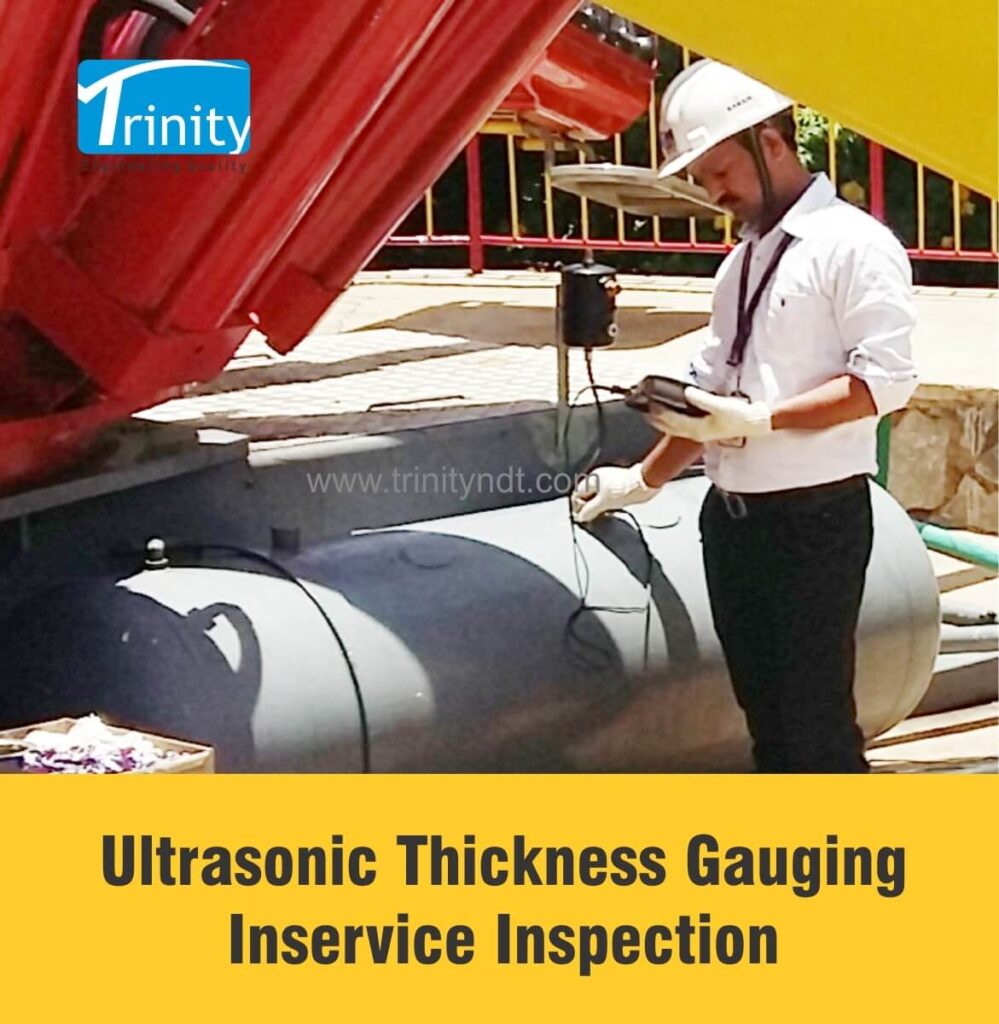
Ultrasonic thickness Gauging (UTG) Level II course includes measuring wall thickness of boiler pipes, tubes, hollow machined components, castings, plates and chimneys.
Also in-service inspection using UT thickness gauge for pressure vessels and corroded pipes. Every Ultrasonic thickness gauging certification course is embedded with practice under ASNT Level 3 trainers.
NABL ISO17025:2017 Accredited NDT Center
Trinity NDT – Testing Services Labs are NABL ISO17025 accredited. Practical training is held at our labs in Peenya Industrial Area, Bengaluru.
The testing Labs have facility for
NAS410 Level III Consulting service on following for Aerospace NDT testing
Our Other NDT & Welding Inspection Courses
Enrol in India's Most Practical UTG Level II Course — Real Instruments, Real Corrosion
Olympus 38DL Plus · Corroded Pipe Specimens · High-Temp Probes · API 570 Calculations Online batches run monthly. Offline lab sessions strictly limited to 12 per batch. Training coordinator responds within 2 hours.
📞 +91 98441 29439 | 📧 training@trinityndt.com | Peenya, Bangalore