NABL vs NADCAP: What's the Real Difference, and Why Should You Care?
If you’ve spent any time sourcing an NDT testing lab in India, you’ve almost certainly seen both acronyms sitting side by side on a vendor’s website — usually right under the logo, in bold letters: “NABL & NADCAP Accredited.” It looks impressive. It’s meant to. But here’s a question worth asking before you sign a purchase order: do you actually know what separates the two, or are you just trusting that more letters after a company’s name means more quality?
You wouldn’t be alone if the honest answer is “not really.” We get this question almost weekly from procurement teams, QA managers, and even engineering graduates walking into our lab for the first time. So let’s actually settle it — properly, without the marketing gloss.
The Short Answer
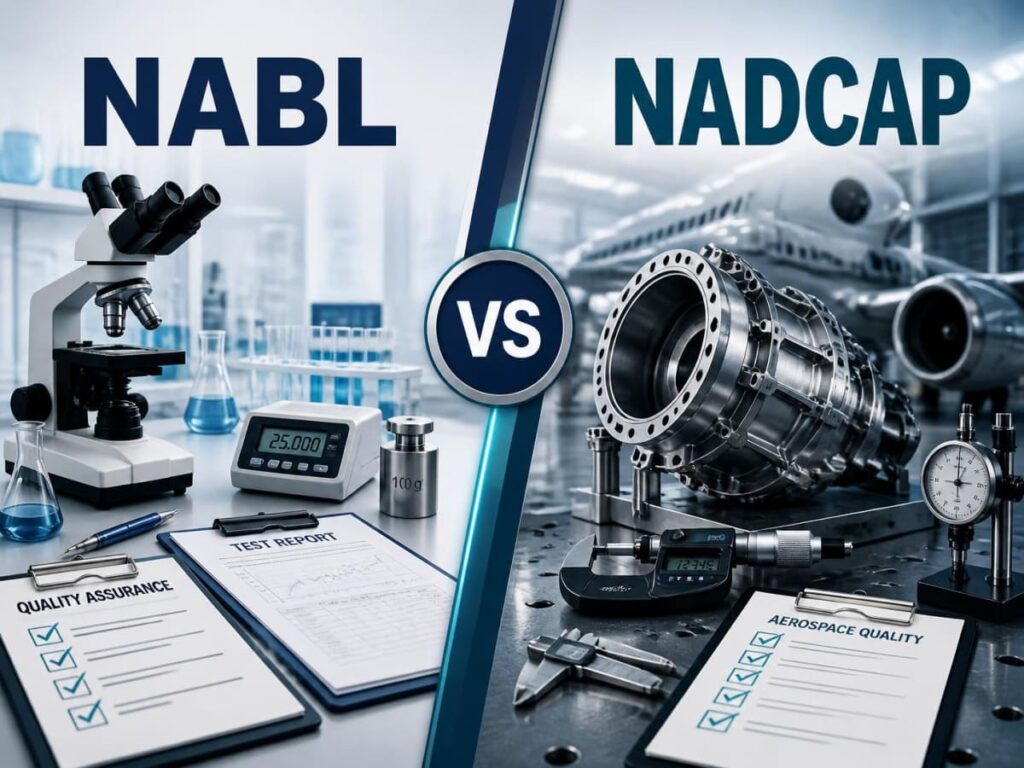
NABL accredits laboratories. NADCAP accredits processes — specifically for the aerospace supply chain.
That one sentence does most of the work, but it’s worth unpacking, because the practical implications for your business are bigger than they sound.
What Is NABL, Exactly?
NABL — the National Accreditation Board for Testing and Calibration Laboratories — is India’s national accreditation body, set up under the Quality Council of India (QCI). It assesses testing and calibration laboratories against ISO/IEC 17025:2017, the international standard that defines what a competent laboratory looks like: how it manages equipment calibration, how it trains and evaluates personnel, how it handles samples and documentation, and how it estimates measurement uncertainty.
Think of NABL accreditation as a stamp that says: “This lab has a functioning quality system, and its test results can be trusted to a defined level of technical rigour.” It applies broadly — mechanical testing, chemical testing, electrical testing, biological testing, and, relevant to us, non-destructive testing (NDT).
Because NABL operates under the ILAC Mutual Recognition Arrangement (ILAC MRA), a NABL-accredited test report isn’t just accepted in India — it carries weight in over 100 countries whose accreditation bodies are also ILAC signatories. That’s a big deal if you’re exporting components or dealing with an overseas client who wants proof your lab isn’t marking its own homework.
What Is NADCAP, and How Is It Different?
NADCAP (National Aerospace and Defense Contractors Accreditation Program) is a different animal altogether. It isn’t a government body — it’s an industry-managed program run by PRI (Performance Review Institute), on behalf of major aerospace primes like Boeing, Airbus, Rolls-Royce, Safran, and GE Aerospace, among others.
NADCAP doesn’t just check whether your lab is competent in general. It audits whether your specific special process — Fluorescent Penetrant Inspection (FPI), Magnetic Particle Inspection (MPI), Radiography, Heat Treatment, Welding, Non-Conventional Machining, and others — meets the exacting, prescriptive requirements written into aerospace industry specifications (AC7114 for penetrant/MPI, AC7126 for RT, and so on).
The audits are notoriously detailed. NADCAP auditors don’t just review your procedures — they’ll watch an actual FPI line running, check your black-light intensity readings against calibration logs from that morning, verify your penetrant materials are on the approved QPL (Qualified Products List), and cross-examine your technicians on technique. It’s less “does this lab have a quality system” and more “will this exact process reliably catch a crack in a turbine blade, every single time, with zero room for interpretation.”
NABL vs NADCAP — Side by Side
| NABL | NADCAP | |
|---|---|---|
| Governing body | Quality Council of India (Govt. of India) | PRI, on behalf of aerospace primes (industry-managed) |
| Standard used | ISO/IEC 17025:2017 | Aerospace industry specs (AC7114, AC7115, AC7126, etc.) |
| Scope | General lab competence — any test discipline | Specific “special processes” — mostly aerospace |
| Recognition | India + 100+ countries via ILAC MRA | Recognised globally by aerospace OEMs and Tier 1s |
| Audit style | Documented quality management + technical competence | Extremely prescriptive, process-level, witnessed audits |
| Who typically requires it | Oil & gas, automotive, infrastructure, general manufacturing, government tenders | Aerospace, defense, and their approved supply chain |
| Audit frequency & rigour | Periodic surveillance, moderate depth | Frequent, deep, and famously unforgiving |
Why Does This Distinction Actually Matter to You?
If you’re in oil & gas, automotive, heavy engineering, power, or infrastructure — NABL accreditation is usually your baseline requirement. It tells you the lab’s ultrasonic, radiography, or magnetic particle results are technically defensible, traceable, and accepted by regulatory and certification bodies across most of the industrial world. For the vast majority of pressure vessel, pipeline, casting, and structural weld inspection work in India, NABL is the accreditation that matters.
If you’re in aerospace or defense manufacturing — NABL alone won’t get you through the door. Aerospace OEMs and their Tier 1/Tier 2 suppliers are contractually required to source special processes from NADCAP-accredited vendors. No exceptions, no “we’re working on it.” If your NDT partner isn’t NADCAP-accredited for the specific method you need (say, Fluorescent Penetrant Inspection), your components simply cannot enter that supply chain — regardless of how good the lab’s other credentials look.
This is exactly why a genuinely serious NDT lab holds both. NABL demonstrates broad-based technical competence recognised internationally. NADCAP demonstrates that a specific, high-stakes process meets the exact letter of aerospace-grade rigour. One is not a substitute for the other, and any lab claiming otherwise is asking you to take a shortcut you probably shouldn’t take — especially on a flight-critical component.
A Word on “Merit” Status
Within NADCAP, there’s a further distinction worth knowing: Merit accreditation. Labs that consistently perform well across audit cycles — few or no findings, strong self-audit history — can be granted Merit status, which extends the audit interval. It’s effectively NADCAP’s way of saying “this facility has earned a longer leash because its process discipline is consistently excellent,” rather than being audited at the standard frequency. It’s a meaningful marker of sustained quality, not a one-time achievement.
How to Actually Verify a Lab’s Accreditation (Don’t Just Take the Website’s Word)
Before you commit to an NDT vendor, do this:
-
- Ask for the accreditation certificate and scope document — not just the logo. NABL and NADCAP certificates list the exact test methods, standards, and sometimes even material/thickness ranges covered. A lab can be “NABL accredited” for hardness testing but not for radiography — the scope document tells you the truth.
- Cross-check on the official registers. NABL maintains a searchable directory of accredited labs on its website, and PRI/NADCAP publishes a supplier list (eAuditNet / Qualified Manufacturers List) searchable by company name and process.
- Check the expiry and last audit date. Accreditations lapse or get suspended. A certificate photo from three years ago tells you nothing about today.
- Match the scope to your actual need. NADCAP for MPI doesn’t mean NADCAP for FPI. NABL for UT doesn’t automatically cover RT. Get specific.
Where Trinity NDT Fits In
At Trinity NDT WeldSolutions, we hold NABL accreditation under ISO/IEC 17025:2017 across our core NDT disciplines, and NADCAP Aerospace Merit accreditation for our Fluorescent Penetrant Inspection (FPI) and Magnetic Particle Inspection (MPI) lines — audited and re-audited to the same standard that HAL, Dassault Aviation, GE, Siemens, and BEL rely on for their supply chains. That combination is deliberately rare in South India, and it’s why manufacturers move between “general industrial” work and aerospace-grade inspection under one roof, without switching vendors.
If you’re evaluating whether your current NDT partner’s accreditation actually covers what your project needs, it’s worth a five-minute conversation before it becomes a rejected shipment. Check our full accreditation scope and certificates here, or if you’re specifically sourcing aerospace-grade inspection, take a look at our NADCAP-accredited aerospace NDT lab.
Frequently Asked Questions
Is NADCAP better than NABL? Neither is “better” — they answer different questions. NABL certifies overall lab competence across a broad range of tests and is recognised internationally through ILAC. NADCAP certifies that a specific special process meets aerospace industry requirements. Most non-aerospace industrial work only requires NABL; aerospace work requires NADCAP for the relevant process, often alongside NABL.
Can a lab have NADCAP without NABL? Yes, technically — they’re independent programs. But in practice, labs serious enough to pursue NADCAP’s rigour almost always already hold, or are pursuing, NABL as well, since it underpins general measurement traceability and international recognition.
Does NABL accreditation expire? Yes. NABL accreditation is typically valid for a defined cycle and subject to periodic surveillance audits and renewal assessments. Always check the certificate’s validity dates rather than assuming a logo on a website is current.
Do I need NADCAP for automotive or oil & gas NDT? Almost never as a mandatory requirement — NABL is generally sufficient and is what most OEMs, EPCs, and regulatory bodies in these sectors ask for. NADCAP is specific to the aerospace and defense supply chain.