Visual Testing (VT) & Weld Inspection Level I & II Certification Course
The Foundation of Quality Inspection — Learn to See What Others Miss ASNT SNT-TC-1A · ISO 9712 · CSWIP 3.0 Pathway · Online & Offline · Bangalore, India
- 👁️IWE & ASNT/ISO9712 Level III Trainers
- 🏆NABL + NADCAP Accredited
- 🔧Welding Gauges & Equipment Practicals
- 🌍42+ Countries Represented



Years Experienced Trainers With IWE & NDT Level III
30
+
Certifications Issued in 6 NDT Methods
18000
+
Countries Participants Since 2001
45
+
of Aerospace NDT is Visual Testing
80
%
Visual Testing(VT), Welding Inspection Level I, II Training & Certification Course in Bangalore
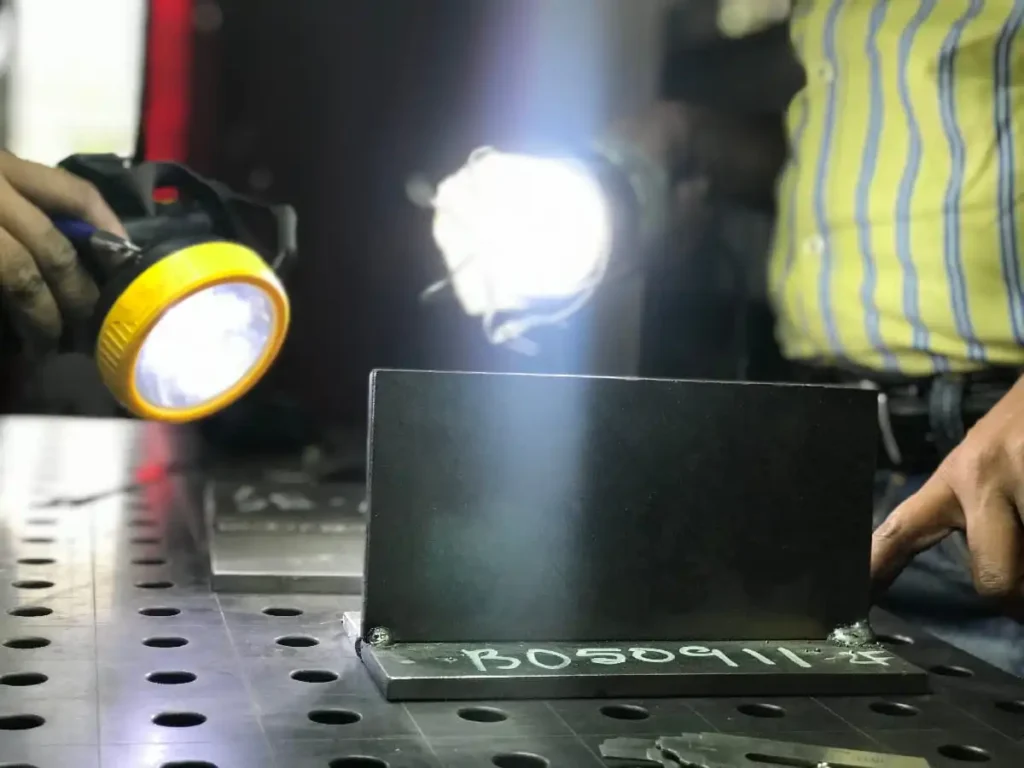
Visual Testing (VT) is the first and most fundamental of all Non-Destructive Testing methods. Before any other NDT technique is applied — whether Ultrasonic Testing, Radiographic Testing, or Magnetic Particle Testing — a thorough visual examination must be completed. In aerospace alone, over 80% of all NDT inspection activity is visual testing.
Despite its apparent simplicity, professional VT requires a trained eye, thorough knowledge of welding processes. And defect morphology, mastery of measurement tools, and familiarity with applicable codes and standards. In modern quality critical industries such as aerospace, oil and gas, pressure vessel fabrication, power generation, railways, and automotive. VT Level I and Level II certification is a mandatory minimum qualification for any quality inspector working in welding fabrication companies.
About Trinity NDT WeldSolutions Pvt Ltd, VT Training Programs
Trinity NDT WeldSolutions Pvt. Ltd, offers VT Level I and Level II certification training at its world-class facility in Peenya, Bangalore. Our VT course is uniquely structured around real welding inspection practice — taught by International Welding Engineers (IWE) and ASNT Level III certified instructors with over 28 years of active weld inspection experience. VT graduates from Trinity NDT are qualified not only for SNT-TC-1A and ISO 9712 certification but are also excellently prepared for the CSWIP 3.0 Certified Welding Inspector examination — one of the most sought-after welding credentials in the global market.
Training is available in online (live virtual) and offline (in-person at Peenya) formats. Onsite at-your-facility delivery available anywhere in India. Also check our welder training courses in Bangalore.
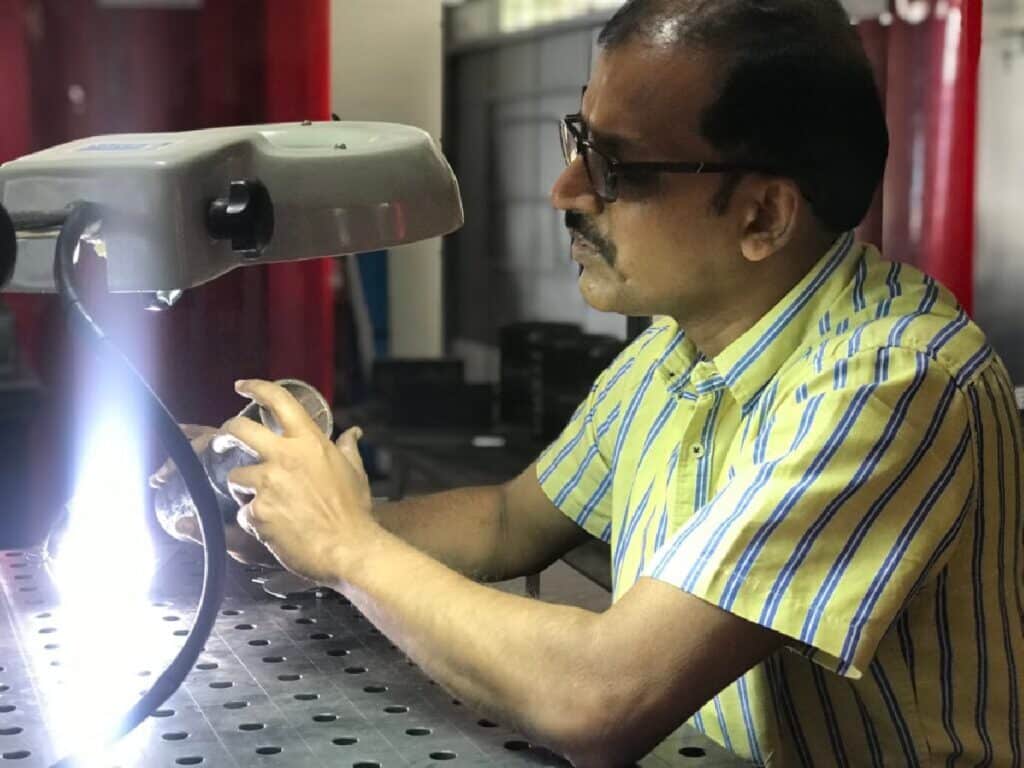
CSWIP 3.0 preparation India
🎯 VT Level II — Your Pathway to CSWIP 3.0 Certified Welding Inspector
Trinity NDT's VT Level II course covers the exact welding inspection knowledge base required for the internationally recognised CSWIP 3.0 (Certified Welding Inspector) qualification from TWI, UK. Many of our VT Level II graduates successfully progress to CSWIP 3.0 certification — one of the highest-paying welding inspection credentials worldwide.
- VT Level II covers weld symbols, welding procedures (WPS), dimensional verification, defect identification and acceptance criteria — all core CSWIP 3.0 subjects
- Trinity NDT is a CSWIP Exam Preparatory Training Provider — dedicated CSWIP 3.0 prep courses available
- Graduates who complete both VT Level II and our CSWIP 3.0 prep course consistently achieve high first-attempt pass rates
VT Course Details at a Glance
| Parameter | VT (SNT-TC-1A) Offline |
VT (SNT-TC-1A) Online |
ISO 9712 VT Offline |
|---|---|---|---|
| Duration | 2 Days (16 Hours) | 2 Days (Live Online) | 3–4 Days (per ISO 25107) |
| Levels Available | Level I & II | Level II | Level I & II |
| Batch Size | Max 15 participants | Max 15 participants | Max 10 participants |
| Training Hours (SNT) | 16 hrs (Level I+II combined) | 16 hrs (theory) | Per ISO 25107 |
| Practical Equipment | Welding gauges, borescope, weld specimens | Theory only (practical add-on available) | Welding gauges, weld specimens, codes |
| Certificate Issued By | Employer / Trinity NDT | Employer / Trinity NDT | TWI India Pvt Ltd (ISO 17024) |
| Examiner | Trinity NDT ASNT Level III / IWE | Trinity NDT ASNT Level III / IWE | TWI India Pvt Ltd (Third Party) |
| CSWIP 3.0 Prep Value | ✅ Excellent foundation | ✅ Good theory preparation | ✅ Strong alignment with CSWIP 3.0 |
| Onsite at Your Location | ✅ Pan-India | N/A | ✅ Pan-India |
Eligibility Requirements — Who Can Enrol?
The requirements for Visual testing (VT) Level I, II certification as per SNT TC 1A of ASNT. Before registering for a course, make sure you check eligibility for the level of NDT certification.
Refer to the chart below for the prerequisites and experience according to SNT TC 1A-2020. Additionally, you must have adequate colour and distance vision. An ASNT Level III or a registered opthalmologist must conduct the eye exam. Download the Eye Fitness document format.
| Criterion | VT Level I (SNT-TC-1A) |
VT Level II (SNT-TC-1A) |
VT Level II (ISO 9712) |
|---|---|---|---|
| Minimum Education | 10th Standard (High School) | 10th Standard with Experience or Diploma/Graduate in Engineering | Per ISO 9712 Annex A |
| Work Experience | 70 Hours | 140 Hours (210 Hours for Direct Level II without Level I) | Per ISO 9712 Annex A (product-form specific) |
| Vision Requirement | Near vision (Jaeger J1 or 0.8 Times New Roman N4.5) + Colour vision | Near vision + Colour vision | Per ISO 9712 Clause 6 |
| Pre-requisite | None — ideal first NDT course | None (combined Level I+II batch) | None for direct Level 2 entry |
| Training Hours (SNT-TC-1A) | 8 hours minimum | 16 hours minimum (Level I+II combined) | Per ISO 25107 |
| Best Suited For | Freshers, welders, fitters, production technicians new to quality | QC engineers, welding inspectors, fabrication supervisors, NDT inspectors | Engineers needing internationally portable third-party certification |
📌 VT Level II is the recommended starting point for engineers seeking a career in welding inspection or quality assurance. It is also the ideal foundation before pursuing the CSWIP 3.0 Certified Welding Inspector qualification. Contact our training coordinator for personalised eligibility guidance: training@trinityndt.com | +919844129439
VT Inspection Equipment — Hands-On Training with Professional Tools
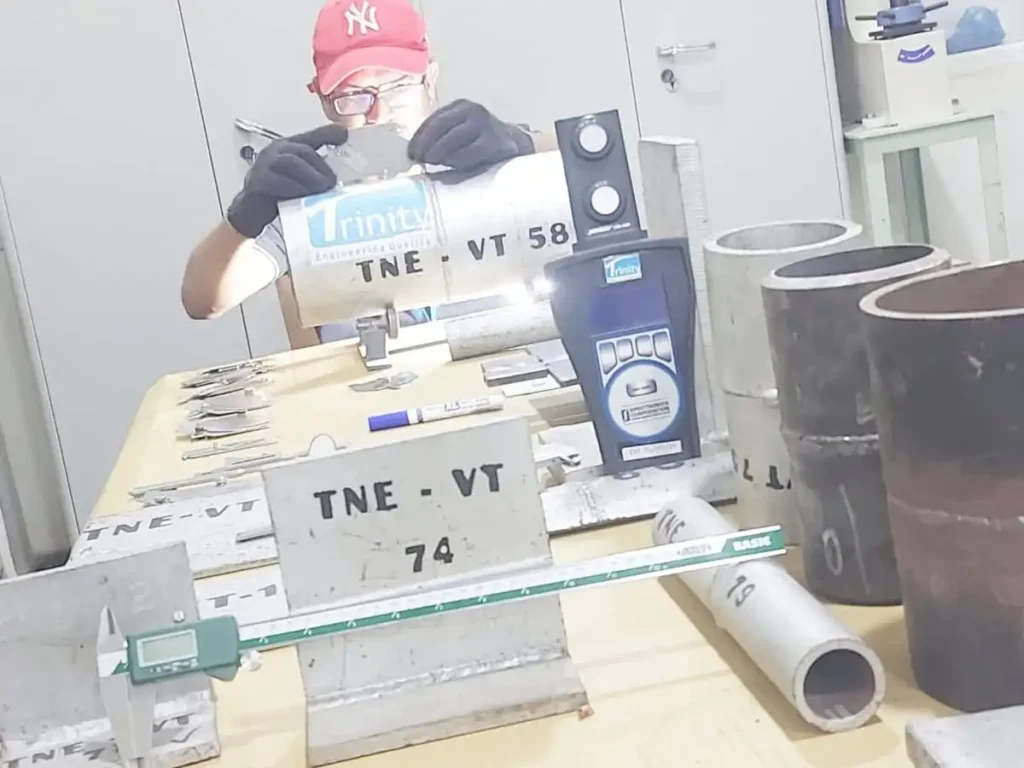
Visual Testing is far from “just looking at something.” Professional VT uses a precise arsenal of inspection tools. At Trinity NDT, offline trainees get hands-on practice with every instrument below — not just demonstrations. By course end, every participant is confident and competent using the complete toolkit of a professional weld inspector.
Bridge Cam Gauge
Measure weld reinforcement height, undercut depth, fillet weld size, crown height, depth of pitting. The most versatile and widely used welding gauge in industry.
Hi-Lo Gauge (Root Hi-Lo)
Measure pipe and vessel root offset (mismatch/misalignment). Mandatory check per ASME Section VIII and B31.3 before welding.
Fillet Weld Gauge Set
Measure fillet weld leg length and throat. Verify per AWS D1.1 minimum fillet size requirements.
Magnifying Lens (2x, 4x, 10x)
Detect fine surface cracks, porosity, and toe defects that are invisible to the unaided eye.
Digital Lux Meter
Measure illumination level in lux at the inspection surface — verify minimum 500 lux (ASTM E165) or 1000 lux (ISO 17637) is achieved.
Rigid & Flexible Borescope
Inspect internal surfaces of tubes, pipes, nozzles, and inaccessible cavities — practical hands-on demonstration on mock-up specimens.
Video Borescope (RVI)
Remote Visual Inspection using camera-in-a-tube technology — used extensively in aerospace, power generation, and pressure vessel inspection.
Undercut Gauge
Precisely measure undercut depth at weld toes — accept/reject per AWS D1.1 (max 1/32" depth) and ASME Section VIII limits.
Weld Replica Tape
Take surface profile impressions of welds for dimensional records — used when direct measurement is not possible.
Where VT Certified Inspectors Work — Industries & Applications

Welding & Fabrication Shops
Pre-weld, in-process, and post-weld inspection at every stage of production. Over 80% of weld defects are surface defects detectable by VT.
Aerospace & Defence
VT accounts for over 80% of all NDT in aerospace. Airframe, engine components, structural welds, and fastener inspections. NADCAP scope.
Oil & Gas & Petrochemical
Pipeline weld inspection per API 1104; in-service vessel inspection per API 510; in-service piping per API 570; tank bottom inspection per API 653.
Power Generation (IBR Boilers)
Boiler drum and header weld inspection; steam piping visual examination; pressure part condition monitoring; IBR complianc
Railways & Rolling Stock
Bogie frame weld inspection; structural weld quality monitoring; coach fabrication quality control. CRS (Commissioner of Railway Safety) inspections.
Automotive & CNC Machining
Dimensional verification of precision machined parts; surface condition of castings, forgings, and stampings; weld quality in automotive sub-assemblies.
Why Engineers Across 45+ Countries Choose Trinity NDT for VT Training?
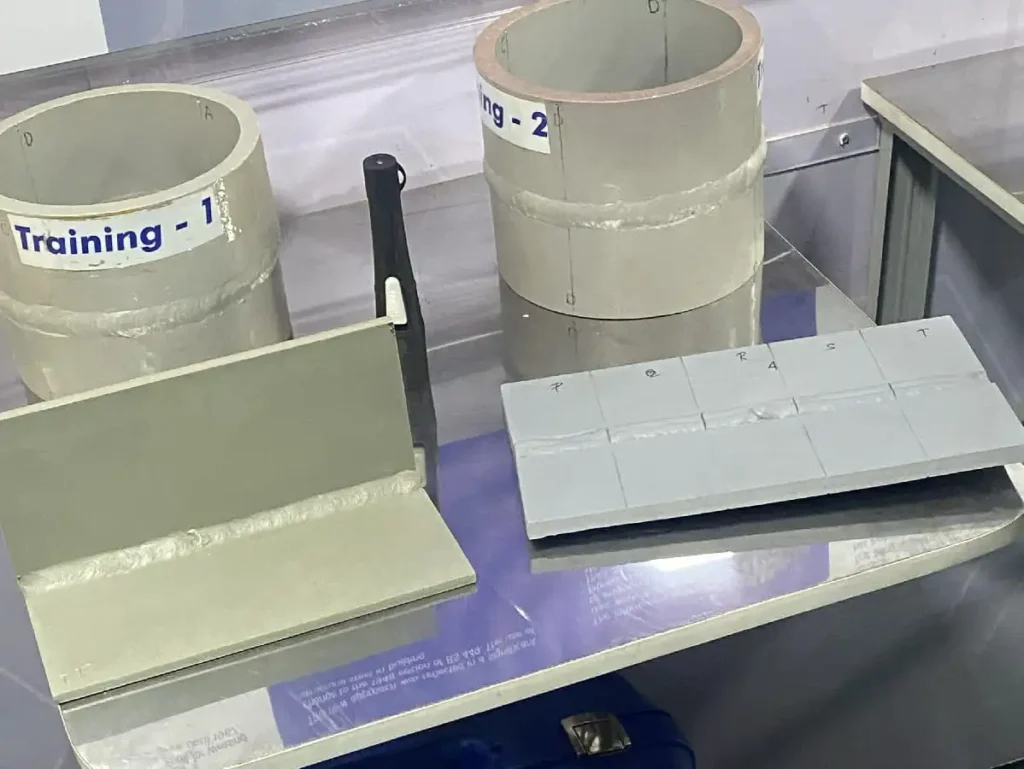
Taught by International Welding Engineers (IWE)
Trinity NDT's VT course is conducted by IWE-certified trainers — the highest international welding engineering qualification from IIW. This means you learn from professionals who do weld inspection every single day — not just teach it.
ASNT/ISO9712 Level III Instructors with 30+ Years Experience
All VT courses are delivered by ASNT/ISO9712 Level III certified professionals. Unlike institutes that use Level II instructors for Level II training, we hold ourselves to the highest standard.
NABL + NADCAP Accredited Practice Environment
Your training takes place within the same facility where we perform accredited production inspection for aerospace, oil & gas, and manufacturing clients — giving you the professional environment that a real inspection career demands.
Full Welding Gauge Set for Every Trainee
Every offline participant works with a complete set of professional welding gauges — not just a demonstration set at the front of the room. One-gauge-per-person ratio gives genuine hands-on competence.
CSWIP 3.0 Pathway Preparation
Our VT Level II course is specifically structured to prepare you for the CSWIP 3.0 examination — one of the highest-value welding inspection credentials in the global market. More Trinity NDT graduates pursue CSWIP than any other follow-on certification.
16,000+ Certified — 45+ Countries
Since 2001 we have trained and certified NDT professionals from Nigeria, UAE, Saudi Arabia, Kenya, Azerbaijan, Bangladesh, and 40 other countries. When you train at Trinity NDT, you join a truly international professional community.
Choose Your Learning Mode — Online or Offline
Offline — In-Person at Bangalore
- 2-day classroom sessions at Aspire Auditorium, 4th Phase Peenya
- Full hands-on practical with professional welding gauges on actual weld specimens
- Borescope and video RVI equipment demonstration and hands-on practice
- Defect identification on physical weld samples — not photographs
- Written + practical examination on Day 2
- Certificate issued within one week
Best for: Freshers and engineers who want maximum hands-on gauge practice and weld inspection confidence.
Online — Live Virtual (Anywhere)
- Live instructor-led sessions via Zoom / Teams — not recorded playback
- Full 16-hour theory curriculum covered over 2 days
- Digital study materials, welding symbol charts, and code extracts sent in advance
- Interactive exercises including weld symbol reading and defect identification from photographs
- Written general + specific examination conducted online under supervision
- Certificate issued post-examination
Best for: Working professionals, engineers in remote locations, and international participants seeking SNT-TC-1A Level II certification.
📌 On-site VT training is available anywhere in India. Our IWE-certified trainers travel to your facility and deliver the full VT Level I/II course on your premises — ideal for companies with 8 or more candidates. Contact us for on-site training quotations: training@trinityndt.com | +9844129439
Examinations for Visual Testing Course
After completion of the course, individual have to take examinations. Examination will be held as per requirements of SNT TC 1A. Candidate has to secure pass marks to be eligible for awarding Visual Testing Level II certificate/s. Learn more about NDT examinations.
Career Opportunities After VT Level II Certification
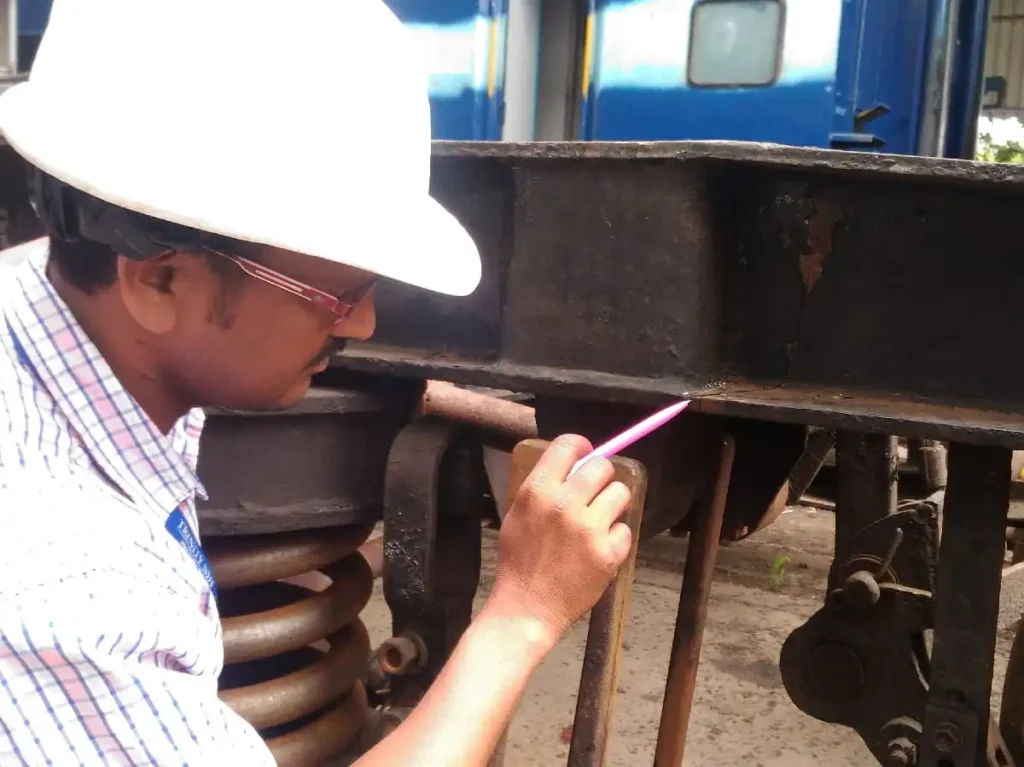
VT Level II is one of the most practical and immediately job-ready certifications in the NDT and quality inspection field. It is a mandatory minimum qualification for most QC/QA inspector roles in India and abroad, and it opens doors to a wide range of well-paying careers.
Job Roles
- Visual Testing Inspector / Weld Inspector — QC departments in fabrication, oil & gas, power, railways
- QA/QC Engineer
- Welding Inspector
- NDT Technician Level II
- Inspection Supervisor
- Quality Control Executive
- Remote Visual Inspector
- CSWIP 3.0 Certified Welding Inspector — International welding inspection roles (Middle East, Europe, UK, Africa, Australia)
Salary & Market Demand
- Fresher VT Level II — ₹2.5–4 LPA (India)
- Experienced VT Inspector (2–5 years) — ₹4–8 LPA (India)
- VT Inspector with CSWIP 3.0 (Gulf / Middle East) — USD 2,500–5,000/month + accommodation + travel
- Senior Welding Inspector (offshore/oil & gas) — USD 4,000–8,000/month
- Demand in India: Government’s “Make in India” manufacturing push has created 50,000+ new QC/NDT inspector vacancies since 2021
- Placement Support: Trinity NDT offers free placement assistance to certified graduates — no fee charged to candidates or employers
Upcoming VT Level I & II Training Batches — 2026
| Dates | Course | Scheme | Mode | Seats | Action |
|---|---|---|---|---|---|
| Contact for Dates | VT Level I & II | ASNT SNT-TC-1A | Offline — Bangalore | Open | Enquire |
| Monthly | VT Level II | ASNT SNT-TC-1A | Online — Live Virtual | Open | Enquire |
| Contact for Dates | ISO 9712 VT Level II | ISO 9712 | Offline — Bangalore | Limited | Enquire |
📅 Full yearly calendar with all dates: View Complete Training Schedule →
What Our VT Course Graduates Say
I was a mechanical engineer with no inspection experience when I joined Trinity NDT's VT Level II course. The hands-on welding gauge sessions were exceptional.
Mr Narayanappa
Managing Director, SLN Precision
I did the online VT Level II from Saudi Arabia where I was working as a welder's helper. The weld symbol exercises and code interpretation sessions were delivered brilliantly by Shiva Kumar sir.
Mr Tufail Ahmed
— Welding Inspector, Star Oil & Gas Construction LLC, Saudi Arabia
Our company sent 12 engineers to Trinity NDT's onsite VT Level II course — they came to our facility in Chennai and delivered the full course here. The IWE trainer was outstanding.
Mr Mahendran N
— QA Manager, Professional EPC Contractor, Chennai ★★★★★
Frequently Asked Questions — VT Level I & II Certification Courses
Yes — Visual Testing is widely recommended as the ideal first NDT certification for engineers beginning a career in quality inspection. It requires no specialised equipment to understand the fundamentals, builds your foundation in weld inspection, defect recognition, and code interpretation, and is directly applicable from Day 1 of work.
CSWIP 3.0 (Certified Welding Inspector from TWI, UK) and VT Level II cover significant overlapping subject matter — particularly weld inspection procedures, welding symbols, defect identification and acceptance criteria.
All offline VT Level II participants practice with the full professional welding gauge kit used by certified weld inspectors worldwide: Bridge Cam Gauge, Hi-Lo Gauge, Fillet Weld Gauge Set, Undercut Gauge, Cambridge Digital Gauge, and Weld Profile Gauge.
VT Level II certified inspectors are employed across oil and gas, pressure vessel fabrication, power generation (IBR boilers), aerospace, railways, construction and structural steel, automotive, and pipeline construction. In India, a fresher VT inspector can expect ₹2.5–4 LPA, rising to ₹4–8 LPA with 2–5 years experience.
Yes — the VT Level II live-virtual online course is available to participants from anywhere in the world. We have trained participants from Nigeria, Ghana, Cameron, UAE, Saudi Arabia, Kuwait, Azerbaijan, Bangladesh, and many other countries through our online VT Level II batches.
Yes — our IWE-certified and ASNT Level III trainers are available for on-site VT Level I/II training delivery anywhere in India. This is most cost-effective for companies with 8 or more candidates in one batch.
Start Your Weld Inspection Career — Enrol in VT Level II Today
IWE + ASNT/ISO9712 Level III Trainers · Welding Gauge Practicals · CSWIP 3.0 Pathway
Online batches run monthly. Offline batches fill fast — secure your seat now.
Training coordinator responds within 2 hours on all working days.
📞 +91 98441 29439 | 📧 training@trinityndt.com | Peenya, Bangalore
Explore Other NDT Certification Courses at Trinity NDT
For information about individual NDT Courses, read details about each method.
You can also download outline for each NDT course.