Reliable, Portable Hardness Testing Services, Onsite.
India’s Premier NADCAP Aerospace + NABL ISO 17025 accredited NDT lab. Serving 1500+ clients in 45+ countries since 2001.
Portable Hardness Testing Services — On-Site, Accurate & Fully Traceable. In Bangalore, India.
ISO/IEC 17025:2017 Accredited Labs | ASNT Level III Supervised | PAN India Service
Your pressure vessel is complete. The welds are done. NDT testing has cleared. But one critical question remains unanswered before your inspector signs off:
Did the PWHT actually work? Is the HAZ hardness within the code limit?
That question can only be answered by hardness testing — and when your component weighs 10 tonnes, cannot leave the shop floor, or is already installed in the field, you need a portable hardness testing service that comes to you.
Trinity NDT WeldSolutions Pvt. Ltd. provides certified, on-site portable hardness testing services across Bangalore, South India, and PAN India. For industries including oil and gas, pressure vessels, power generation, aerospace, structural fabrication, and defence manufacturing. Our hardness testing results are reported to international standards, supervised by ASNT Level III, International Welding Engineer IWEs and ISO9712 Level III certified engineers, and backed by our accreditations.
What Is Portable Hardness Testing?
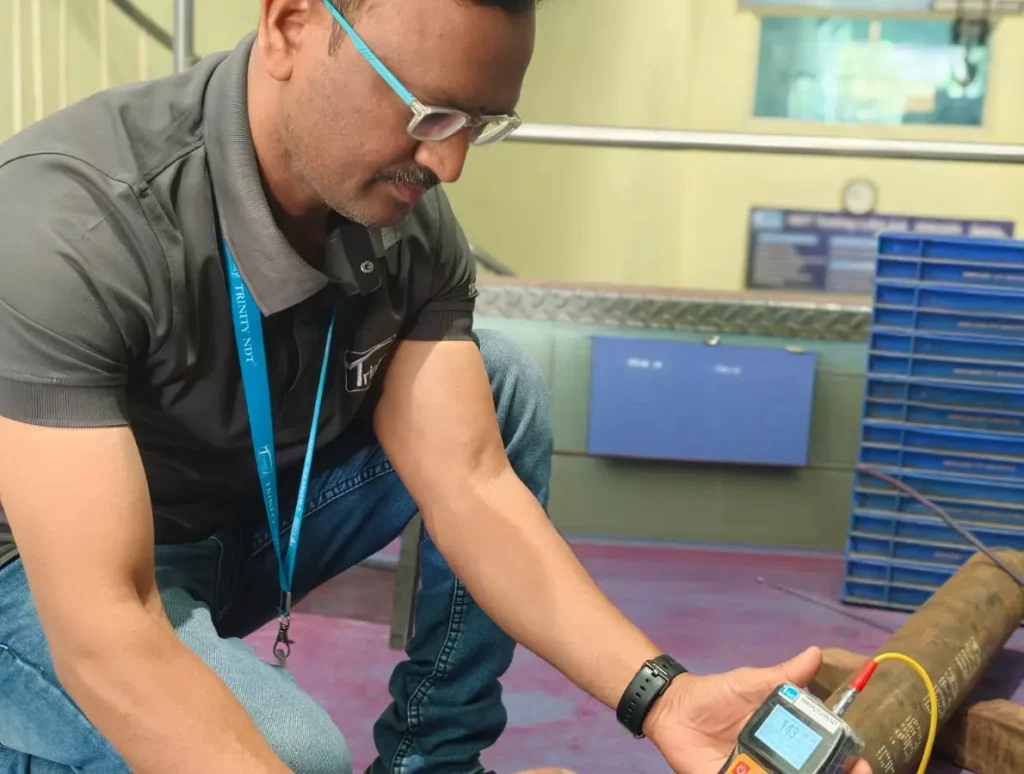
Portable hardness testing is a non-destructive method of measuring the hardness of metals, alloys, welds, and heat-affected zones (HAZ) without removing the component from service or the shop floor. Unlike laboratory hardness testing methods that require small, prepared specimens, portable hardness testing can be performed directly on large fabrications, installed equipment, and in-service structures.
The hardness of a weld joint — measured in Brinell (HBW), Rockwell (HRC), Vickers (HV), or Leeb (HL) units — tells a trained welding engineer a great deal about the metallurgical condition of the joint. It indicates whether the post weld heat treatment (PWHT) was effective, whether hard and brittle microstructures are present in the heat-affected zone, and whether the weldment is safe for its intended service environment.
Hardness Testing Methods Available at Trinity NDT
Leeb Impact Ball Bounce (LIBB) — Dynamic Portable Hardness Testing
The Leeb method (also called rebound or dynamic hardness testing) is the most widely used portable hardness testing technique in industrial applications today. A spring-loaded impact body with a carbide ball tip strikes the test surface at a defined velocity. The ratio of rebound to impact velocity, measured electromagnetically, gives the Leeb hardness value (HL) which is then converted to HB, HRC, HV, or HS using ASTM E140 conversion tables.
At Trinity NDT, our Leeb testing is performed in accordance with ASTM A956/A956M and ISO 16859-1:2015, using calibrated instruments verified against NABL-traceable reference blocks. Our written procedure (TNE-HT-LIBB-01) governs all LIBB testing performed under our quality management system.
The Leeb method is ideal for testing large components, installed equipment, and locations that are inaccessible to bench-type hardness testers. Multiple impact device types (D, DC, DL, G, C) allow testing in confined spaces, bores, pipes, and curved surfaces.
When Is Portable Hardness Testing Required?
Understanding when portable hardness testing is not just useful but mandatory is something our Level III engineers assess for every job before mobilisation. The following are the most common mandatory and recommended applications:
PWHT Verification — The Most Critical Application
Post weld heat treatment (PWHT) is performed to relieve residual stresses and temper hard HAZ microstructures in welded joints. But PWHT is only effective if it achieves the intended metallurgical result. The only way to verify this is through hardness testing of the weld metal, HAZ, and base metal after the PWHT cycle is complete.
Under ASME BPVC Section VIII, ASME B31.1, and ASME B31.3, hardness testing after PWHT is either mandatory or strongly recommended depending on the material and service conditions. For chrome-moly and alloy steel welds, PWHT verification hardness testing is universally required. For carbon steel above 38mm wall thickness (or 19mm for B31.1/B31.3 piping), PWHT verification provides documented evidence of compliance.
Trinity NDT performs PWHT verification hardness surveys on pressure vessels, heat exchangers, reactors, piping spools, and structural weldments across Bangalore and PAN India. Our reports document hardness at base metal, HAZ on both sides of the weld, and weld metal — with acceptance/rejection status against the applicable code limit.
Sour Service and NACE MR0175 / ISO 15156 Compliance
Equipment exposed to wet hydrogen sulphide (H2S) service — pipelines, separators, pressure vessels, wellheads — must comply with NACE MR0175 / ISO 15156 hardness limits. The standard specifies a maximum hardness of 22 HRC (248 HBW) across all zones of the weld joint. Exceeding this limit in sour service is not a paperwork non-conformance — it is a material condition that leads to sulphide stress cracking (SSC) and hydrogen-induced cracking (HIC), both of which can cause catastrophic failure without warning.
Our certified engineers perform 100% hardness surveys of all weld joints on sour service equipment, mapping weld metal, HAZ, and base metal hardness to demonstrate full NACE compliance. Results are documented with individual readings, means, and acceptance status against the 22 HRC / 248 HBW limit.
In-Service Inspection and Fitness for Service Assessment
Installed equipment that has been in service for years may have experienced changes in hardness due to hydrogen embrittlement, temper embrittlement, or other service-related degradation. Portable hardness testing during turnarounds and planned shutdowns provides critical data for fitness-for-service (FFS) assessments per API 579-1 / ASME FFS-1.
Our Level III engineers do not just perform the hardness test — they interpret the results in the context of the material, service history, and applicable code, providing a complete assessment report rather than just raw data.
Weld Procedure Qualification (WPS/PQR) Hardness Surveys
ASME Section IX, EN ISO 15614-1, and AWS D1.1 all require hardness traverses on weld procedure qualification test pieces as part of the PQR documentation. Trinity NDT’s Centre of Excellence in Welding regularly performs hardness traverses on PQR test pieces for clients qualifying new welding procedures, ensuring all data is reported to the format required by the applicable code.
Incoming Material Verification
Large fabricators and engineering companies use portable hardness testing to verify the hardness of incoming materials — plates, pipes, forgings, castings — against material certificates. This is a practical and rapid check against material mix-up that is significantly faster and cheaper than spectroscopic analysis for hardness-related verification.
Industries We Serve
Our portable hardness testing services are trusted by quality departments, inspection agencies, and engineering consultants across:
Oil and Gas — Pressure vessels, piping systems, separators, heat exchangers, flanges, NACE-compliant equipment
Power Generation — Boiler drum welds, main steam piping, turbine components, generator casing repairs
Aerospace and Defence — Component hardness verification, repair weld assessment, NADCAP-context hardness surveys
Automotive and Heavy Engineering — Press frames, dies, moulds, shafts, gears, axle housings
Shipbuilding and Offshore — Hull welds, structural members, offshore platform components
Chemical and Petrochemical — Reactor vessels, column shells, agitator shafts, high-pressure fittings
Structural Steel Fabrication — Bridge girders, industrial structures, crane jibs, mast sections
Applicable Codes and Standards
All portable hardness testing services at Trinity NDT are performed in accordance with applicable international codes and standards including:
| Standard | Application |
|---|---|
| ASTM A956 / A956M | Leeb hardness testing of steel products |
| ISO 16859-1:2015 | Leeb hardness test method |
| ASTM E10 | Brinell hardness testing |
| ASTM E18 | Rockwell hardness testing |
| ASTM E140 | Hardness conversion tables |
| ASME BPVC Section VIII Div.1 | Pressure vessel acceptance criteria |
| ASME B31.1 | Power piping hardness requirements |
| ASME B31.3 | Process piping hardness requirements |
| EN ISO 15614-1 | Weld procedure qualification hardness |
| NACE MR0175 / ISO 15156 | Sour service hardness limits |
| API 579-1 / ASME FFS-1 | Fitness for service hardness assessment |
Why Choose Trinity NDT for Portable Hardness Testing?
Every hardness test report issued by our laboratory carries the weight of internationally recognised accreditation — accepted by clients, inspection bodies, and third-party authorities across India and globally
ASNT Level III and IWE Supervised Testing
Our hardness testing operations are supervised by ASNT Level III certified engineers who are also qualified as International Welding Engineers (IWE). This combination is unique in India — it means our engineers understand not just how to measure hardness, but what the hardness values mean in the context of welding metallurgy, failure mechanisms, and applicable code requirements. We do not just hand you a number — we tell you what it means and whether your component is safe.
Rapid Mobilisation — Bangalore and PAN India
Based in Peenya Industrial Area, Bangalore, our engineering team can mobilise to any location in Karnataka, Tamil Nadu, Andhra Pradesh, Telangana, Maharashtra, and across India. For shutdown-critical jobs, we offer same-day and next-day mobilisation for clients within Bangalore.
Calibrated Equipment with Traceable Certificates
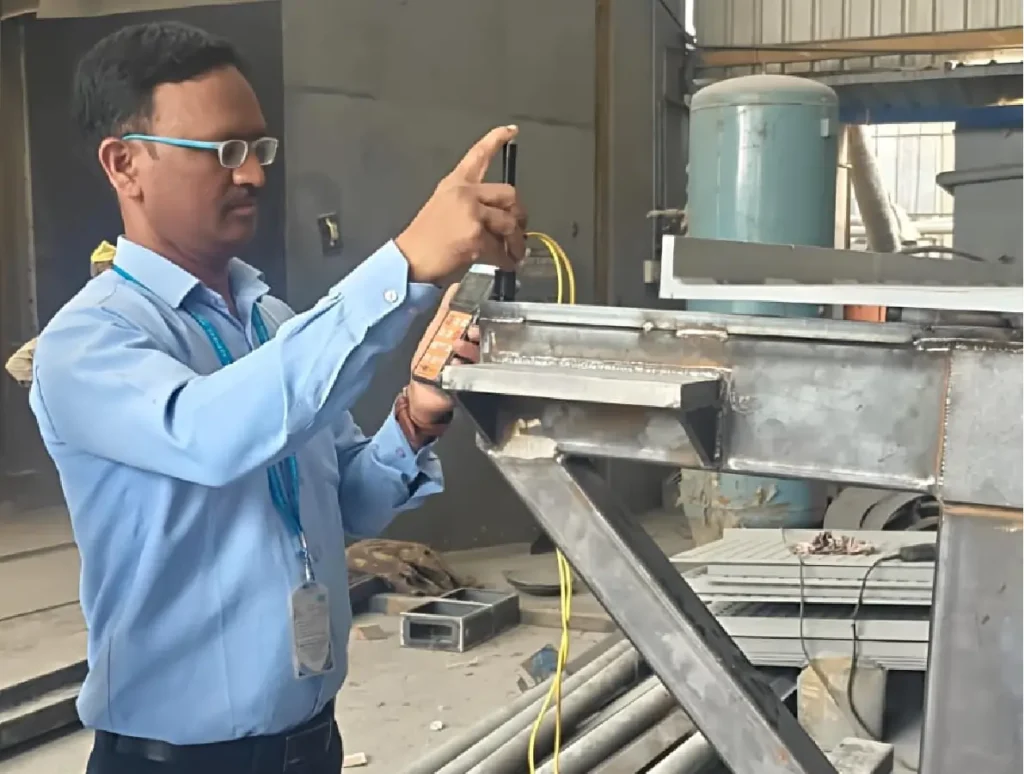
All our hardness testing instruments are calibrated at defined intervals and verified against NABL-traceable reference blocks before every testing session. Calibration records are available with every test report.
Comprehensive, Code-Ready Reports
Our hardness test reports are structured to meet the documentation requirements of ASME, AWS, NACE, EN ISO, and client-specific quality management systems. Every report includes individual readings, means, acceptance criteria, instrument details, calibration verification, and examiner certification details — everything your QA department, third-party inspector, or statutory authority needs in one document.
Hardness Scale Quick Reference
| Scale | Unit | Typical Application |
|---|---|---|
| Leeb | HL | On-site, all metals, portable testing primary output |
| Brinell | HBW | Castings, forgings, coarse-grain steels |
| Rockwell C | HRC | Hard steels, NACE limit verification |
| Rockwell B | HRB | Soft steels, aluminium alloys |
| Vickers | HV | Thin sections, PQR hardness traverses, precision parts |
Frequently Asked Questions
-
1. Can portable hardness testing replace lab Brinell or Rockwell testing for code purposes?
For most industrial codes including ASME, AWS, and EN ISO, portable Leeb testing with validated conversion to HB or HRC is accepted as an equivalent alternative for in-situ testing where specimen removal is not practical. Our Level III engineers confirm the applicable acceptance criteria before testing and document the conversion method used.
-
2. How many test points are required per weld joint?
For PWHT verification, a minimum of three zones per weld joint are tested — base metal, HAZ each side, and weld metal — with a minimum of five individual impacts per zone. For NACE MR0175 compliance surveys, 100% of weld joints are typically tested.
-
3. What is the minimum wall thickness for Leeb testing?
For the standard Type D Leeb device, the minimum component thickness is 10mm and minimum mass is 1kg (unsupported). For thinner or lighter components, special compact devices and fixturing are used. Our engineers assess accessibility and minimum thickness requirements during job planning.
-
4. Do you provide testing at customer site or only at your lab?
Both. On-site mobilisation across India is our primary service for portable hardness testing. We also accept components and test pieces at our Peenya laboratory for bench testing, PQR hardness traverses, and research or failure investigation requirements.
-
5. How quickly can we get a test report?
For standard on-site testing, same-day preliminary reports are provided on site. Final signed and stamped reports are issued within 24 hours of completion of testing.
-
6. Is your report accepted by TPIA/Third Party Inspection agencies?
Yes. Recognised by almost all major third-party inspection agencies operating in India.
Request a Quote or Technical Consultation
Whether you need PWHT verification hardness testing, a sour service NACE compliance survey, weld procedure qualification hardness traverses, or in-service inspection hardness mapping — our team is ready to discuss your requirements and provide a detailed proposal.
📞 Call / WhatsApp: +91 98441 29439 | +91 91413 39969 📧 Email: info@trinityndt.com 📍 Laboratory: 491, Site No.12, 14th Cross, 4th Phase, Peenya Industrial Area, Bangalore — 560 058 🌐 Website: www.trinityndt.com
Free Portable Hardness Testing Procedure (LIBB) available for download at our NDT Procedures and Report Formats page.