

Phased Array Ultrasonic Testing (PAUT) Training Course Level I & Level II Certification | ASNT SNT-TC-1A | ISO 9712
Master Advanced UT Techniques with India's Premier Training Institute.
ISO17025 & NADCAP Accredited NDT Labs.
Hands-On Training | Olympus Equipment | ASNT Level III Instructors | 16,000+ Certified Professionals


Duration
40 Hours
Mode of Training
Physical at Bangalore, India
Job Assistance
After Course Completion
International Recognition
Participants from 45+ Countries
Phased Array Ultrasonic Testing - PAUT Advanced NDT Courses
Are you ready to advance your career in non-destructive testing? Our Phased Array Ultrasonic Testing (PAUT) training course equips you with cutting-edge skills demanded by industries worldwide. Unlike conventional ultrasonic testing that uses single-element probes, PAUT employs multiple-element transducers to create detailed, three-dimensional images of welds and components. This revolutionary technique has become the industry standard for critical inspections in aerospace, oil and gas, power generation, and manufacturing sectors.
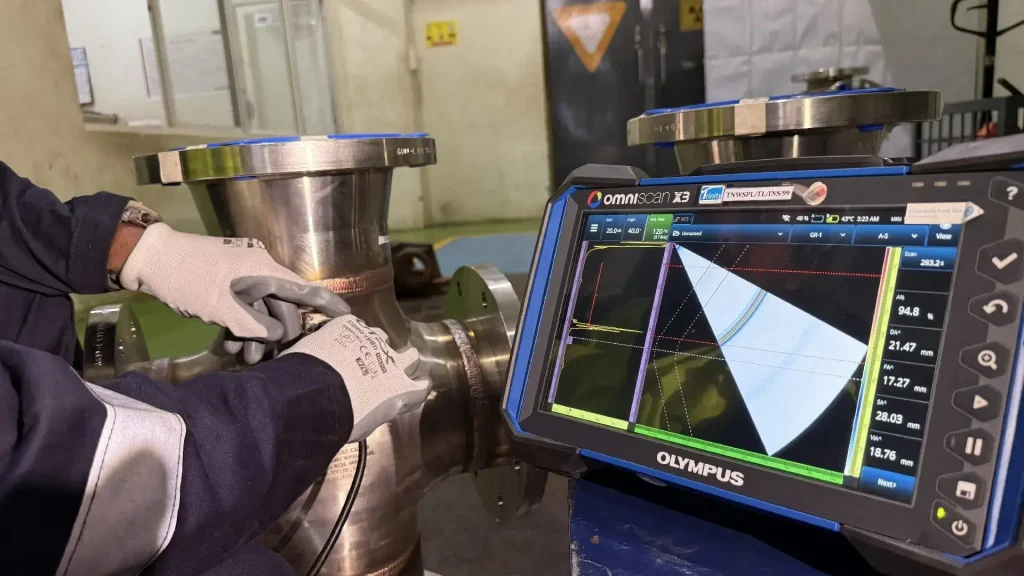
Since 2001, Trinity Institute of NDT Technology has trained over 16,000 professionals from 45+ countries. Our PAUT certification program combines expert classroom instruction with extensive hands-on practice on Olympus OmniScan X3 equipment—the same technology used in world-class inspection facilities. Whether you’re a UT Level II professional looking to upgrade your skills or a quality engineer entering advanced NDT, our comprehensive training prepares you for real-world challenges.
Why Choose PAUT Training at Trinity NDT
Train on Professional PAUT Equipment
Learn on Olympus OmniScan X3—the industry's most advanced phased array system. Our ISO 17025 accredited labs provide hands-on experience with the same equipment used in aerospace, petrochemical, and nuclear facilities. You'll master real-world applications, not theoretical concepts.
Expert ASNT Level III Instructors
With 30+ Years of Experience. Our ASNT Level III certified trainers bring decades of field experience from critical industries. They've inspected everything from aircraft components to nuclear pressure vessels. You'll learn industry secrets, troubleshooting techniques, and best practices that textbooks don't teach.
Career Support for PAUT Professionals
Job Placement Assistance Included. Join our network of 16,000+ certified professionals working across 45 countries. We provide resume building, interview preparation, and direct connections to hiring companies. Many of our graduates receive job offers before completing certification.
What You'll Learn in Our PAUT Training Program
1: PAUT Fundamentals
- Phased array principles and beam steering technology
- Differences between conventional UT and PAUT
- Understanding focal laws and array element configuration
- Acoustic field characteristics and beam modeling
2: Equipment Operation
- Olympus OmniScan X3 system operation
- Probe selection and characterization
- Scan plan development and setup procedures
- Data acquisition parameters and optimization
3: Calibration & Setup
- Sensitivity and DAC curve setup for PAUT
- Wedge characterization and verification
- Time-Corrected Gain (TCG) calibration
- Reference standards and test block usage
4: Scanning Techniques
- Linear scanning for weld inspection
- Sectorial scanning applications
- Electronic raster scanning
- Encoded and manual scanning methods
5: Data Interpretation
- Reading S-scan, B-scan, C-scan, and D-scan displays
- Flaw characterization and sizing
- Generating inspection reports
- Understanding ASME Section V requirements
6: Practical Applications
- Weld inspection of pressure vessels
- Pipeline girth weld scanning
- Corrosion mapping and thickness surveys
- Aerospace component inspection
- In-service inspection procedures
Who Should Attend This PAUT Course?
Ideal Candidates
✅ UT Level II certified professionals seeking advanced skills
✅ Quality engineers in aerospace, oil & gas, or manufacturing
✅ Mechanical engineers working in fabrication or inspection
✅ NDT technicians looking to specialize in advanced techniques
✅ Fresh UT Level II graduates wanting competitive advantage
Prerequisites
Required:
- Valid UT Level II certification (ASNT SNT-TC-1A or ISO 9712)
- Basic understanding of ultrasonic testing principles
- Minimum 6 months UT practical experience recommended
Helpful (Not Required):
- Familiarity with weld inspection procedures
- Knowledge of ASME Section V or equivalent codes
- Basic computer skills for software operation
- After completing PAUT training, many students also pursue TOFD certification
PAUT Certification Process & Examination
Your Journey to Becoming a Certified PAUT Professional
1
Training
32 Hours
Complete classroom theory and equipment familiarization. Master the fundamentals of phased array technology, beam steering principles, and OmniScan system operation.
2
Hands-On Practice
8 Hours
Supervised practical training on live test pieces and welds. Gain real-world experience with probe selection, calibration procedures, and scan technique optimization.
3
Written Examination
Comprehensive theory test covering PAUT principles and standards. Evaluate your understanding of focal laws, scan configurations, ASME requirements, and defect interpretation.
4
Practical Examination
Demonstrate proficiency in equipment setup, scanning, and interpretation. Show mastery in real-world inspection scenarios under the supervision of ASNT Level III examiners.
5
Certification Issuance
Receive Trinity NDT certificate as per Employer's written practice framed to SNT-TC-1A. Join thousands of certified professionals working across aerospace, oil & gas, and manufacturing industries worldwide.
🎓 Certification Recognition & Validity
- Certificate valid for employers following SNT-TC-1A written practice
- Meets supplemental training requirements for advanced UT applications
- Internationally recognized across 45+ countries
- Lifetime alumni support and recertification assistance
PAUT Training Schedule & Fee Details
Upcoming Batch at Bangalore, India
04 – 07, February 2026
Last Date for Registration
20, January 2026
Fee Details per Candidate*
Rs.24,999/- without certification (participation certificate will be issued)
With certification as per SNT TC 1A – Rs.39,999/-
*GST Extra
Notes:
- You must hold a valid UT Level II certification before enrolling
- Early Bird Discount for Registrations before last date: Special Discount Fee, Contact Training Coordinator on Phone/WhatsApp: +91 98441 2943 | +91 91413 39994
- Group Discount: Special rates for 3+ participants from same company
- Included: Course materials, practice test pieces, lunch, refreshments, and certificate
State-of-the-Art Training Facilities & Equipment

Equipment We Train On
- Olympus OmniScan X3 64-128 Phased Array System
- Multiple phased array probes (linear, matrix, sectorial)
- Calibration blocks compliant with ASTM E2491
- Weld test specimens (carbon steel, stainless steel, dissimilar metals)
- Encoded scanners and fixtures
- Latest OmniPC software for offline analysis
Lab Facilities
- ISO 17025 accredited ultrasonic testing laboratory
- NADCAP approved aerospace testing facility
- Climate-controlled inspection areas
- Individual workstations with dedicated equipment
- Reference standards library
- Video projection for group demonstrations
- Learn about our PAUT inspection services to see real-world applications
Industries Hiring PAUT Certified Professionals
Oil & Gas
Pipeline welding inspection, offshore platform maintenance
Aerospace
Aircraft structural components, engine parts inspection
Power Generation
Nuclear pressure vessels, turbine components, boiler tubes
Construction & Infrastructure
Bridge components, structural steel, high-rise buildings
Marine & Shipbuilding
Hull welds, propeller shafts, pressure hull inspection
Manufacturing
Heavy equipment, automotive components, pressure vessels
Career Growth After PAUT Certification
Job Roles
- Advanced NDT Technician – PAUT Specialist
- Weld Inspection Engineer
- Quality Assurance Engineer – Advanced UT
- Senior NDT Inspector
- PAUT Application Specialist
- NDT Trainer/Instructor
Salary Expectations (India)
- Entry Level (0-2 years): ₹3.5 – 5.5 LPA
- Mid Level (2-5 years): ₹5.5 – 9 LPA
- Senior Level (5+ years): ₹9 – 15 LPA
- Specialist/Consultant: ₹15+ LPA
Note: Salaries are indicative only. Check with other sources. Explore current job openings for PAUT certified professionals
Success Stories from Our PAUT Level II Certified NDT Professionals

“The PAUT training at Trinity NDT completely transformed my career. Within 2 months of certification, I received three job offers. The hands-on experience with Olympus equipment gave me confidence that employers immediately recognized.”
– Rajesh Kumar
UT Level II → Senior PAUT Inspector at L&T
Salary increase: 65%
“As someone transitioning from conventional UT, the PAUT course opened entirely new opportunities. The instructors’ real-world experience and the extensive practical sessions made complex concepts easy to understand.”
– Priya Sharma
Quality Engineer → PAUT Specialist at Tata Projects
Now working on international projects
“Trinity NDT’s job placement support was incredible. They connected me directly with hiring managers. The certificate is recognized internationally—I’m now working in the Middle East at 3x my previous salary.”
– Mohammed Ali
Fresh UT Graduate → PAUT Technician in Dubai
International placement within 45 days
Frequently Asked Questions About PAUT Training
Yes, PAUT is an advanced technique that requires solid foundation in conventional ultrasonic testing. You must hold a valid UT Level II certificate from any recognized certification body (ASNT SNT-TC-1A, ISO 9712, or equivalent) before enrolling in our PAUT course.
PAUT is considered a supplemental or advanced qualification under ASNT SNT-TC-1A. It’s not a separate “Level” but rather specialized training that supplements your existing UT Level II certification. Upon completion, you’ll be qualified to perform PAUT inspections as per your employer’s written practice.
Both are advanced UT techniques, but they work differently:
– PAUT uses electronically steered beams for detailed imaging and flaw detection
– TOFD uses fixed angle probes to detect crack tips through wave diffraction
– PAUT is better for sizing and imaging; TOFD excels at through-wall height measurement
We offer training in both techniques. Many professionals get certified in both for maximum employability.
Yes! We offer online live training with our ASNT Level III instructors. The theory and equipment operation are taught through live virtual sessions with screen sharing and demonstrations. However, you’ll need to complete 8 hours of hands-on practical training at our Bangalore facility for certification, which can be scheduled separately after the online theory portion.
We train exclusively on Olympus OmniScan systems, which are industry standard worldwide. The principles you learn apply to all phased array equipment, but Olympus systems are used by 70%+ of the industry, giving you immediate job readiness.
Absolutely! Our job placement support includes:
– Resume building and interview preparation
– Direct connections with 200+ hiring companies
– Access to our exclusive job portal with daily postings
– LinkedIn profile optimization
– Industry networking opportunities
Many students receive job offers before completing their certification exams.
Under ASNT SNT-TC-1A, certifications are typically valid as per your employer’s written practice, commonly 3-5 years. You’ll need recertification or validation as specified by your employer. We provide refresher courses and recertification exams.
Yes! We’ve trained professionals from 45+ countries. We provide:
– Visa invitation letters for Indian visa applications
– Assistance with accommodation near our training center
– Airport pickup services (on request)
– Certificates recognized internationally
Contact us for special international student packages.
PAUT vs Conventional UT: Understanding the Advantages
See why industry leaders are switching to Phased Array technology
| Feature | Conventional UT | Phased Array UT (PAUT) |
|---|---|---|
| Coverage | Single angle, limited coverage | Multiple angles in single scan |
| Inspection Speed | Slower, requires multiple passes | 5-10x faster inspection |
| Imaging | A-scan only | A, B, C, D, S-scans simultaneously |
| Flaw Sizing | Less accurate | Precise 3D sizing and positioning |
| Documentation | Limited data recording | Complete scan data archived |
| Operator Skill | Highly operator-dependent | More consistent, less variability |
| Complex Geometries | Difficult | Easily adapted with focal laws |
| Cost | Lower equipment cost | Higher initial investment |
| Industry Preference | Traditional applications | Preferred for critical applications |
| Career Opportunities | Moderate | High demand, premium salaries |
💡 Industry Insight: Over 70% of aerospace and nuclear facilities have transitioned to PAUT for critical weld inspections. Companies report 60% reduction in inspection time and 40% improvement in defect detection rates.
Complete Your Advanced NDT Training Portfolio
Time of Flight Diffraction (TOFD) Training
Perfect complement to PAUT for weld inspection
Duration: 32 Hours | Level II Prerequisite
Conventional Ultrasonic Testing Level II Training
Build your foundation before PAUT
Duration: 40 Hours from Level I | Entry Level
Advanced UT Package (PAUT + TOFD)
Complete advanced UT certification
Duration: 72 Hours | Save Upto 20% on Fee
Ready to Advance Your NDT Career with PAUT Certification?
Join 16,000+ professionals who've transformed their careers with Trinity NDT training.
Limited seats available for upcoming batches.